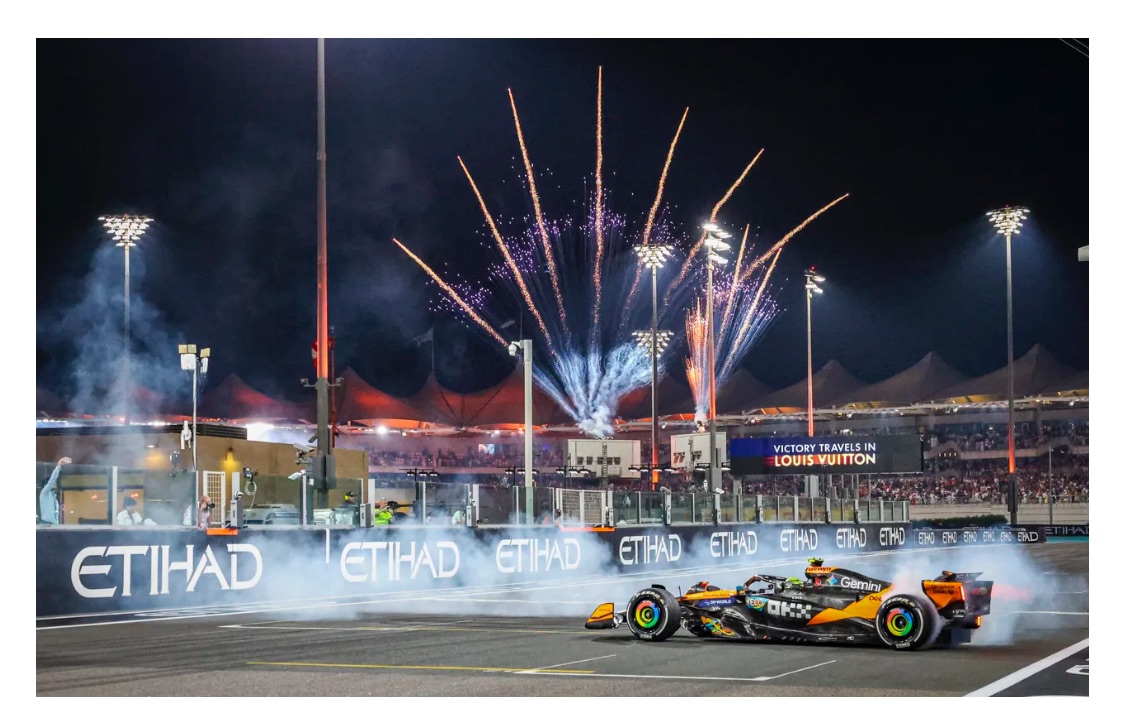
The 2025 season finale at the Abu Dhabi Grand Prix delivered one of the most dramatic and defining moments in recent Formula 1 history: a resurgent driver finally understanding his own worth, a dominant champion undone by a rare lapse — and the quiet, strategic brilliance of a storied team quietly reclaiming its place at the top. At the heart of it all is Lando Norris, newly crowned 2025 World Champion.
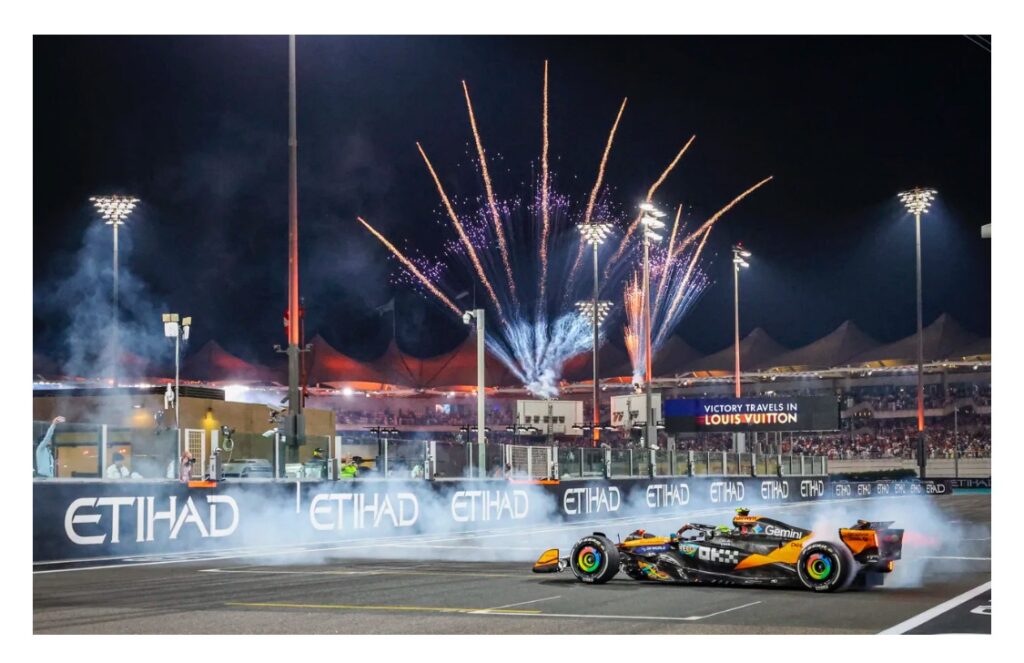
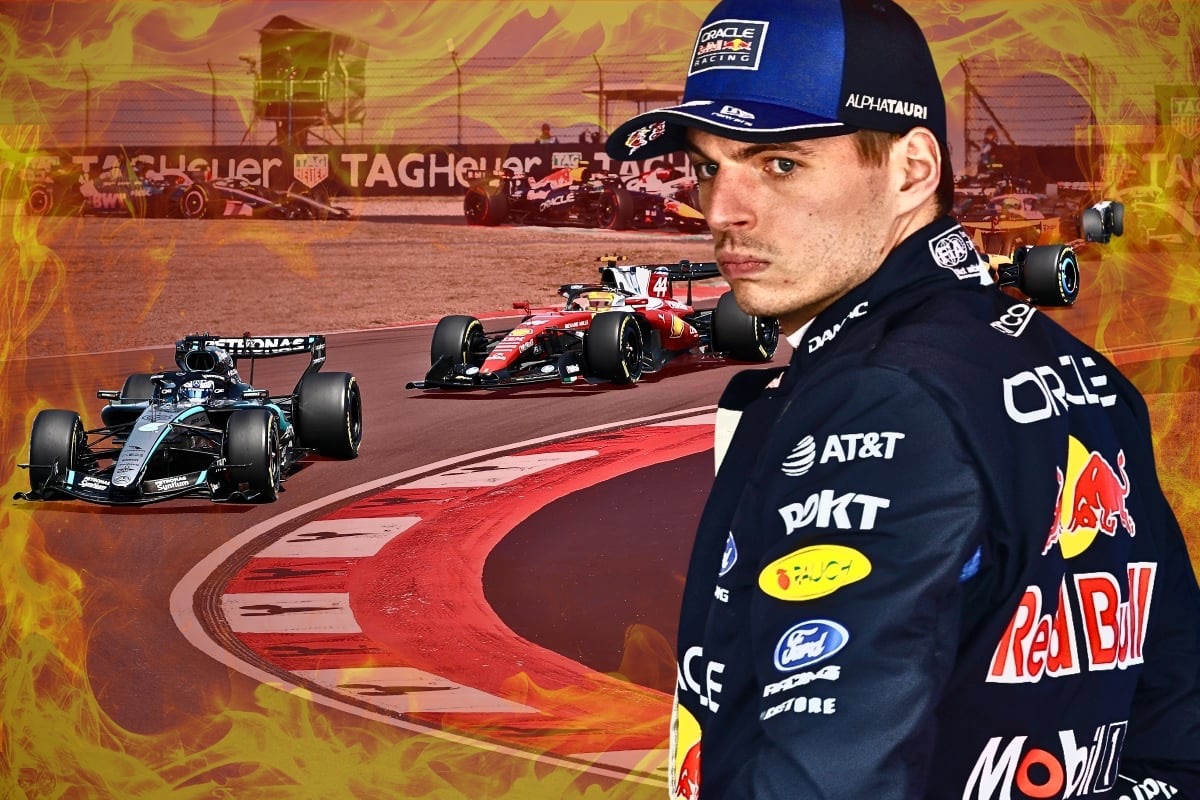
Even though Max Verstappen won the Grand Prix — his eighth win this season — it wasn’t enough to prevent Norris from clinching the title by a mere two-point margin.
Lando Norris — a quiet talent finally at ease
Norris has always had exceptional natural speed and racecraft, but what’s stood in his way equally was his own self-doubt. The article argues that, prior to now, Norris often looked unsure — as if no matter how much raw talent he had, each time he climbed back into a car he needed fresh reassurance.
In sport, the typical pattern is straightforward: talent leads to results, which builds confidence — and that confidence leads to even better results. But in Norris’s case, confidence never seemed to stick persistently.
The write-up reflects on earlier episodes: at the start of a season or after a disappointing qualifying, Norris would sometimes mentally retreat, overwhelmed by what might go wrong instead of trusting what he knows he can do. For example, after a relatively minor qualifying deficit, he reportedly locked himself in McLaren’s hospitality unit and struggled with self-doubt.
That cycle — talent undermined by inner hesitation — raised a serious question: if Lando could be this shaken after a minor setback, what would happen when things got truly tough? The authors point to many such tough moments: being outpaced by teammates, disappointing results, or failed opportunities — particularly in 2024, and during the early half of 2025.
What changed then? According to them, behind the scenes, the team (McLaren) worked to remove pressure where possible. They made deliberate choices — for instance, avoiding burdening Norris with the full weight of constructors’-championship ambitions, or not overloading him with delta-time displays on his steering wheel during qualifying. The goal: let him focus on simply driving, rather than internalizing every race as a referendum on his worth.
By doing that, they seemingly liberated him. At the final race in Abu Dhabi, a visibly happier, calmer Norris drove with clarity. For a driver who once questioned his own potential at every turn, maybe this is the moment he finally understood just how good he really is.
The article suggests that perhaps the real significance of this championship isn’t just the trophy, but what it might do for Norris internally — boosting his belief, stabilizing his confidence, giving him a mental anchor going forward.
A rare slip from Max leads to a harsh lesson
If the title never felt more up for grabs, it was because of a few past mistakes from Verstappen that came back to haunt him. The article frames the 2025 Abu Dhabi finale not just as Norris’s victory — but as the moment when Verstappen’s uncharacteristic lapses were punished.
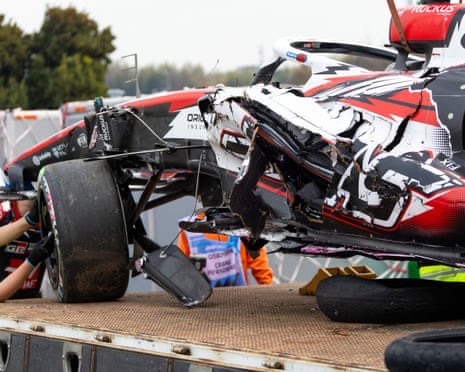
Verstappen is often regarded as virtually faultless: a driver without weakness. Yet, the story reminds readers that this season he had a few missteps — a collision at Barcelona that cost him valuable points, a mid-race meltdown in Hungary, and other penalty-inducing moments in Mexico.
Because the final margin was only two points, those earlier mistakes weren’t just regrets or small blips — they turned into very real, season-defining errors. Even though he dominated many races and put on a strong performance at Yas Marina, the accumulation of past errors ultimately cost him the fifth straight world title he so desperately sought.
To be fair, the article balances the narrative: Verstappen doesn’t wallow in regret. That’s not his style. He doesn’t do weakness. He rarely admits vulnerability, which he sees as giving opponents an advantage — a mindset common among many elite athletes.
But the article argues that this mindset can also be blinding. Underestimating the impact of seemingly minor errors — letting them accumulate — can be a fatal flaw. And in a sport where every point counts, it cost Verstappen dearly this time.
Oscar Piastri: A near-miss that could come back to hurt
Then there is Oscar Piastri — Norris’s teammate at McLaren, and for much of the season, the favourite for the crown. By mid-season (after the race at Zandvoort), Piastri had built a commanding 34-point lead — the biggest gap any driver enjoyed all year.
But heading into Abu Dhabi, he had drifted from favourite to outsider in the final three-way duel. The article posits a blunt question: did 2025 come a bit too soon for him? Perhaps he was thrust into a title fight before fully ready — both mentally and technically.
The season’s pattern supports that interpretation. Piastri’s post-Zandvoort fade came in two waves: a psychological dip — marked by errors, frustrations, and heat-of-the-moment mistakes — followed by technical issues related to adapting to evolving car dynamics and race conditions.
It’s a sobering situation because drivers who’ve blown late-season leads often take time to bounce back: look at former champions who took years to return to form after losing a title under similar circumstances.
Yet, the article remains cautiously optimistic for Piastri. At just three seasons in, to have come this close — and to have demonstrated so much raw speed and composure early on — still suggests a very bright future; just perhaps not this year.
The McLaren way: patience, strategy and long-term thinking
What stands out through the entire narrative is the subtle, mature approach of McLaren. This wasn’t about swagger or arrogance. It was about recognizing problems — internal pressure, self-doubt, team dynamics — and addressing them methodically.
Rather than pushing Norris to chase bold glory, McLaren allowed him to rebuild his confidence in small, manageable steps. They deliberately simplified his approach: in some events they didn’t burden him with all details, in others they removed distracting visual data. The team clearly understood that sometimes, a good driver isn’t just fast — they need to believe they belong.
This long view paid off. In Abu Dhabi, Norris executed the race with the calmness of a driver who knew exactly what he had to do — nothing more, and nothing less. He didn’t need to win; he just needed to finish on the podium. He stayed composed under pressure and resisted the chaos around him.
The result: a championship — and perhaps more importantly, a transformed driver. A “perfectly imperfect” champion, still improving, still learning, still far from “finished.” That potential — not just the trophy — might be the most valuable thing McLaren takes into 2026.
Bigger picture: What Abu Dhabi 2025 says about F1
This finale encapsulated several recurring themes: talent is just place to start; mental strength and consistency matter just as much as raw speed. It showed how even a dominant driver can be undone by small but avoidable mistakes. And it demonstrated how a team’s long-term thinking can pay off more than aggressive, short-term gambits.
For viewers and fans, Abu Dhabi 2025 didn’t just deliver spectacle — it offered a lesson in resilience, humility, and growth. It posed a question: in a sport often defined by instant success and flash, maybe the more subtle path — rebuilding confidence, trusting process, staying grounded — is the one that yields greatness.
For Norris, it may be the start of a new chapter — one where he races not just as a supremely talented driver, but as one confident in his own stakes, ready to fight without self-doubt, and evolving relentlessly. For Verstappen, it’s a reminder that invincibility is a myth. For Piastri, a near miss — painful perhaps, but not the end. For McLaren, a revival grounded not in hype, but in quiet, strategic engineering of character and performance.
Abu Dhabi 2025 was more than a race — it was a crossroads. And in the end, the right choices — mental, strategic, personal — made all the difference.