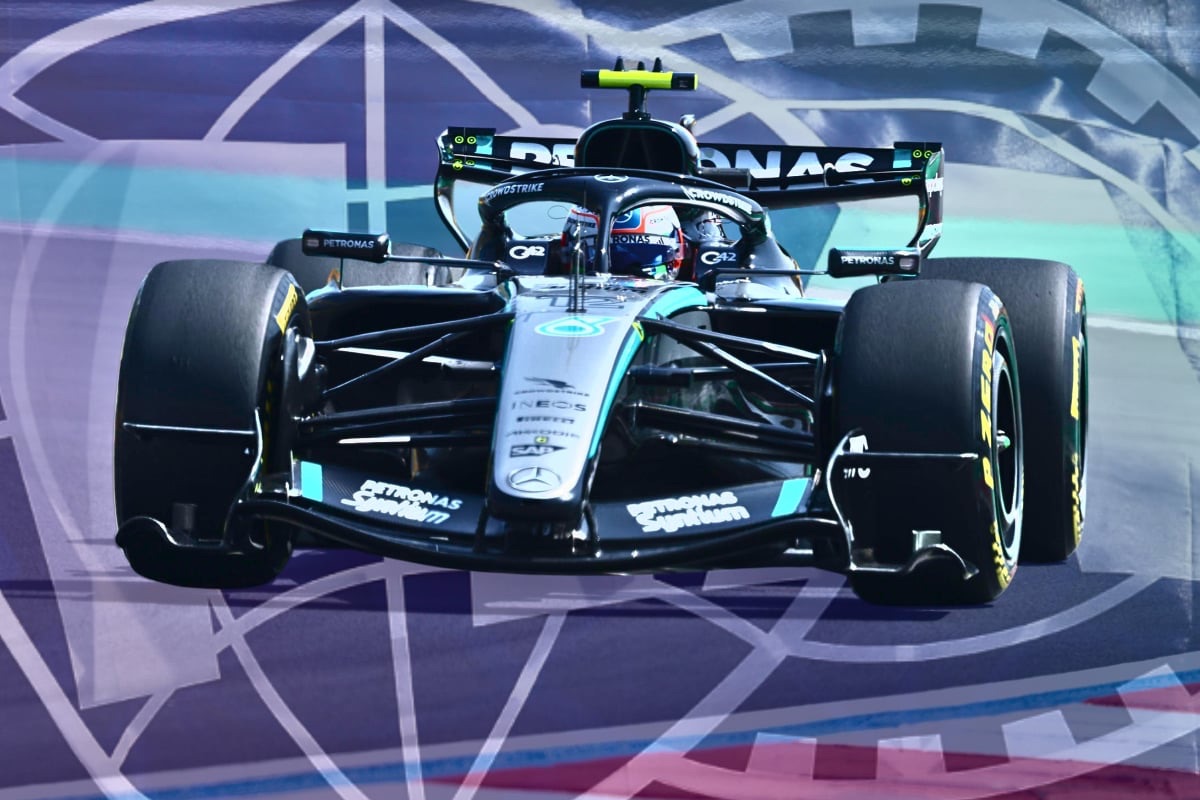
A fresh technical controversy has surfaced in Formula 1, placing Mercedes-AMG Petronas Formula One Team under scrutiny for a potential breach of the sport’s aerodynamic regulations. The issue revolves around the operational speed of the team’s front wing system, which appears to fall outside the limits defined by the FIA’s technical rulebook.
Under Article 3.10.10.o in Section C of the regulations, teams are required to ensure that any transition of the front wing between its “straight-line” mode and “cornering” mode is completed in no more than 400 milliseconds. This rule is designed to prevent teams from gaining an unfair aerodynamic advantage by delaying how quickly the wing adapts to changing track conditions. A similar requirement is also applied to rear wing systems under Article 3.11.6.d, reinforcing consistency across key aerodynamic components.
However, recent analysis by has raised serious concerns about Mercedes’ compliance with these rules. According to their findings, the front wing on the Mercedes car appears to take approximately 800 milliseconds to complete its transition—twice the maximum time permitted. If this assessment proves to be accurate, it would constitute a clear violation of FIA regulations and could potentially trigger an official investigation.
The issue gained widespread attention during a race situation involving George Russell and Charles Leclerc at the Shanghai International Circuit. As both drivers went wheel-to-wheel through Turn 29, observers noted that the Mercedes front wing did not adjust as quickly as expected when switching between aerodynamic configurations. The delay became particularly noticeable under the intense conditions of close racing, where rapid aerodynamic response is crucial for maintaining balance and performance.
In modern Formula 1, aerodynamic systems play a decisive role in determining a car’s competitiveness. Front and rear wings are engineered to adapt dynamically depending on whether the car is traveling at high speed on a straight or navigating corners that require increased downforce. A faster transition ensures that the car remains stable and efficient in all phases of a lap. Conversely, a slower transition—if exploited—could allow a car to remain in a more advantageous aerodynamic state for longer than permitted, potentially improving grip or reducing drag in ways that competitors cannot replicate.
The FIA’s strict 400-millisecond limit exists precisely to eliminate such possibilities. By enforcing a uniform response time, the governing body aims to maintain a level playing field and ensure that no team can manipulate aerodynamic behavior beyond the intended design framework. Any deviation from this standard is treated seriously, as it undermines the principles of fairness and technical equality that underpin the sport.
Despite the claims made by GPFans, there has been no official confirmation from the FIA regarding a breach, and Mercedes-AMG Petronas Formula One Team has not publicly acknowledged any issue with its front wing system. It is possible that further technical analysis, including data review and inspection of the car’s components, would be required before any formal conclusions can be drawn.
If the alleged delay is verified, the consequences for Mercedes could vary depending on the severity of the infringement and whether it is deemed intentional. Potential outcomes could include a directive to modify the design, disqualification from specific sessions, or even points penalties. However, such measures would only follow a thorough investigation and confirmation of non-compliance.
This situation adds another layer of intrigue to the ongoing Formula 1 season, where the margins between teams are already incredibly tight. Even minor technical irregularities can have significant implications for race outcomes and championship standings, particularly when they involve a leading team with a strong competitive history.
As attention turns to the FIA’s next steps, fans and analysts alike will be watching closely to see whether the governing body chooses to investigate further. For now, the controversy highlights the importance of precision in Formula 1 engineering, where performance gains are often measured in milliseconds—and where exceeding those limits, even slightly, can spark major debate.
Ultimately, this development serves as a reminder of how rigorously regulated Formula 1 has become. Every component, system, and response time is carefully monitored to ensure fairness across the grid. Whether or not Mercedes is found to be in breach, the incident underscores the fine line teams must walk between innovation and compliance in the relentless pursuit of performance.