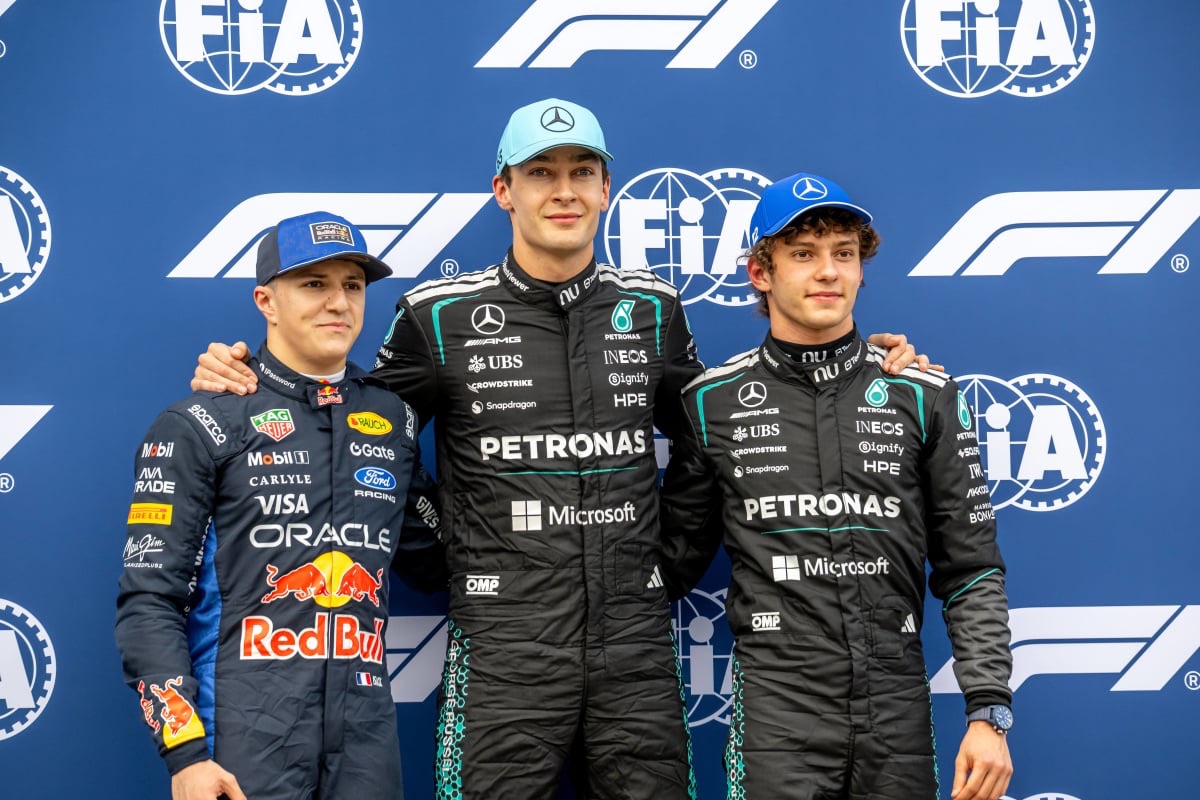
Tensions boiled over between two of Formula 1’s brightest young talents at the Chinese Grand Prix, as a controversial on-track clash sparked a frosty post-race exchange and the emergence of a potential new rivalry.
The incident occurred during the sprint race in Shanghai, where Kimi Antonelli and Isack Hadjar found themselves battling intensely in the midfield. As the pair approached Turn 6, Antonelli attempted an ambitious move that ultimately resulted in contact. The collision caused visible damage to Hadjar’s car, with bodywork flying off his RB machine and compromising his race from that point onward.
While Antonelli managed to continue relatively unscathed and crossed the line in fifth place, Hadjar’s race unraveled. The French driver struggled with the damage and dropped out of contention, eventually finishing down in 15th position, well outside the points. Race stewards later reviewed the incident and deemed Antonelli at fault, handing the young Italian a 10-second time penalty for causing the collision.
However, it was not just the on-track drama that grabbed attention. Post-race footage from onboard cameras revealed an awkward and heated interaction between the two drivers. Antonelli, appearing to acknowledge responsibility, approached Hadjar in the paddock to apologize. He leaned in to speak with him, seemingly hoping to smooth things over after the incident.
Hadjar’s response, however, made it clear that tensions were still running high. The Red Bull junior driver dismissed Antonelli with a wave of his hand, brushing off the apology in a visible display of frustration. The moment, captured on camera, quickly circulated among fans and pundits, adding further fuel to the narrative of a budding rivalry.
Speaking after the sprint race, Hadjar did little to hide his irritation. In an interview with Canal+, he questioned Antonelli’s approach and mindset during the race. He pointed out that the Mercedes driver was already in a strong position, equipped with a highly competitive car capable of making up places without unnecessary risks.
“I don’t really understand why he was pushing so hard in that situation,” Hadjar remarked. “He has a very fast car and was always going to move forward anyway. It just didn’t make much sense to take that kind of risk.” Despite his frustration, Hadjar acknowledged that incidents like these are part of racing, though his tone suggested the matter was far from settled in his mind.
The situation drew mixed reactions from the Formula 1 community. Former driver and Sky Sports Germany pundit Ralf Schumacher weighed in on the exchange, offering a more sympathetic view of Hadjar’s reaction. Schumacher suggested that emotional responses are not uncommon in the heat of competition, particularly among young drivers still finding their footing at the highest level of the sport.
“Normally, you wouldn’t react like that,” Schumacher explained. “But he’s very impulsive, and you have to remember the intensity of the moment. After a race, especially one where something like this happens, emotions are still running high.”
Schumacher emphasized that Hadjar’s reaction should not be judged too harshly, noting that the Frenchman’s passion and competitive drive are qualities that define top-level athletes. He added that such moments often serve as learning experiences, and that maturity tends to come with time.
“He’s completely focused and gives everything to his racing,” Schumacher continued. “That kind of reaction can happen. But as he gains more experience, he’ll likely handle these situations differently in the future.”
While the sprint race controversy dominated headlines, Antonelli quickly shifted focus to the main event—and delivered in spectacular fashion. The Mercedes prodigy bounced back from the penalty setback by producing a stunning performance in qualifying, securing pole position and becoming the youngest polesitter in Formula 1 history.
He carried that momentum into Sunday’s race, converting pole into a landmark victory—his first in Formula 1. The emotional triumph marked a major milestone in Antonelli’s career and underscored his immense potential as one of the sport’s rising stars.
Hadjar’s weekend, in contrast, was more subdued after the sprint race setback. Despite the earlier disappointment, he managed to recover in the main race and secured an eighth-place finish. Notably, he was the only driver from the Red Bull stable to score points, following the retirement of Max Verstappen.
In the end, the Chinese Grand Prix delivered not only dramatic racing but also a glimpse into the future of Formula 1. With talented young drivers like Antonelli and Hadjar pushing the limits and clashing on track, the sport appears set for a new era of fierce rivalries and unforgettable moments.