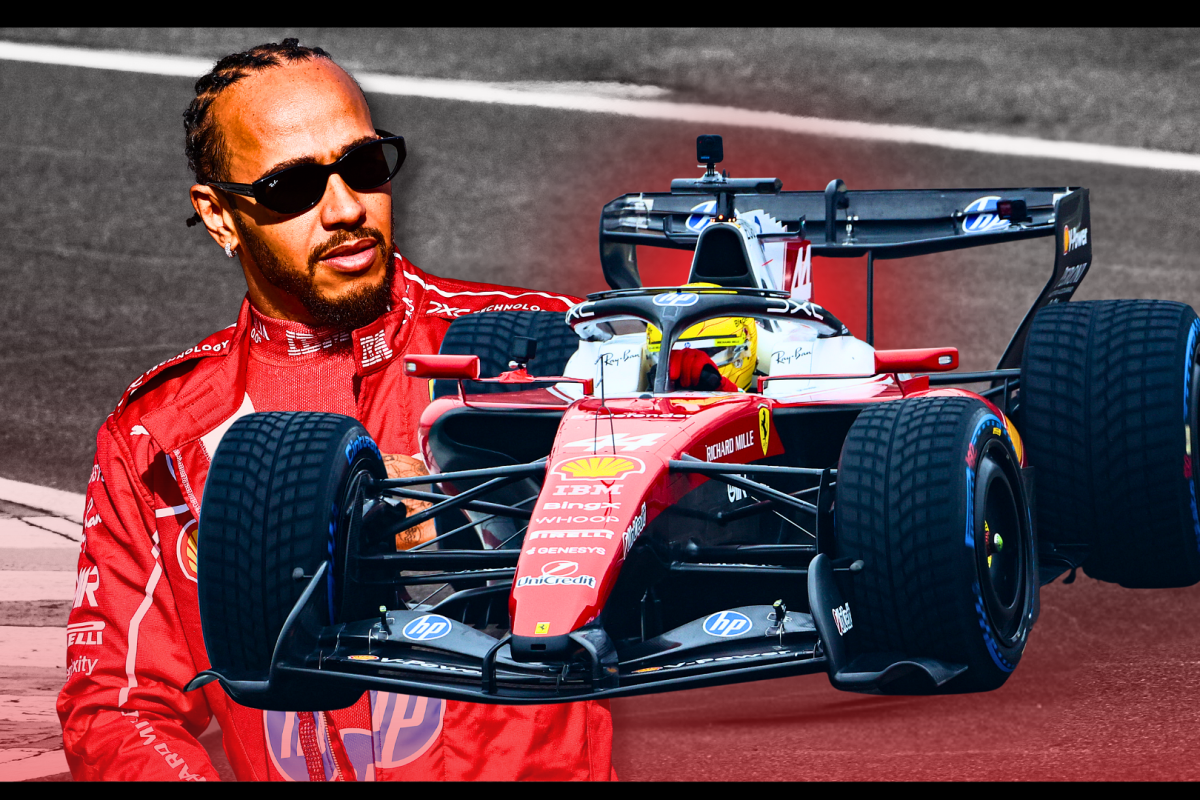
Lewis Hamilton has just five MONTHS to save his F1 career following Ferrari Final D…read more
Lewis Hamilton may be smiling again, but the clock is ticking. As the 2026 Formula 1 season approaches, the seven-time world champion finds himself in a rare position: racing not just rivals on track, but time itself.
Hamilton’s move to Ferrari was meant to be the final, glorious chapter of an already legendary career. After a disappointing first season with the Scuderia following his shock Mercedes departure at the start of 2025, expectations are now sky-high. Encouragingly, the early signs in 2026 suggest a driver who is far more comfortable in his surroundings.
The 41-year-old has looked relaxed and upbeat during pre-season, sharing light-hearted moments with team-mate Charles Leclerc in Ferrari’s social media content and appearing noticeably happier within the team environment. Hamilton also seemed to enjoy Ferrari’s new car during the Barcelona shakedown, topping the timing sheets after the five-day private test at the Circuit de Catalunya.
However, context is everything. Pre-season testing is notoriously misleading. Teams rarely show their true pace, drivers do not push to the absolute limit, and reliability often takes priority over outright performance. Ferrari, like many others, were likely focused on ensuring the car functions smoothly under the new regulations rather than chasing headlines.
Still, compared to the gloomy atmosphere that surrounded Hamilton’s first year in red, the mood has undeniably shifted. The noises coming from his camp are positive, and Ferrari insiders appear quietly optimistic that the partnership may finally click.
Yet optimism alone will not be enough.
Hamilton’s age is now impossible to ignore. While his experience, race craft and technical understanding remain elite, Formula 1 is unforgiving when it comes to physical decline. Reaction times, endurance and raw pace inevitably fade, even for the greatest drivers in history. From Ferrari’s perspective, this means the return on their Hamilton investment diminishes with each passing season.
Year one of the project has already been labelled a failure. As a result, 2026 cannot be treated as another adjustment period. Results are required immediately.
The question, then, is how long does Hamilton realistically have to prove himself?
While it is difficult to set a definitive deadline, the British Grand Prix looms as a critical moment. Scheduled as the 11th round of the season and just shy of the halfway mark, Silverstone will be under intense scrutiny from fans, media and Ferrari management alike. By that point—roughly five months into the campaign—it should be clear whether Hamilton is genuinely in the championship fight or, at the very least, capable of leading Ferrari’s charge.
Central to that judgement will be his performance against Charles Leclerc.
Beating Leclerc is non-negotiable. Ferrari did not sign Hamilton to play a supporting role. They are paying him to win championships, not to finish consistently behind their long-established star. Even a narrow deficit would raise serious questions, particularly when cheaper alternatives exist. Drivers like Carlos Sainz have already shown they can match Leclerc’s pace without commanding a record-breaking salary.
Victories will matter, but the internal battle matters more. Even if Hamilton arrives at Silverstone without a podium in Ferrari colours, having the upper hand over Leclerc would significantly strengthen his position. It would prove that, despite his age, his talent and speed remain intact.
Hamilton does hold an option for a third season with Ferrari in 2027, which would give him another shot at an eighth world title—even at 42. But clauses mean little without momentum. If he spends the early part of 2026 chasing Leclerc rather than leading him, both parties may begin to question whether continuing makes sense.
There is simply no time left for recovery drives, slow starts or extended learning curves. Any loss of pace from this point onward becomes harder to claw back.
For Lewis Hamilton, the mission is clear: start fast, assert authority, and beat his team-mate. The opening race in Melbourne on March 8 will be the first true indicator. From there, every weekend becomes a test of whether one of Formula 1’s greatest ever drivers can still operate at the very top.
Five months. That may be all the time he has to save his Ferrari dream—and possibly his F1 career.