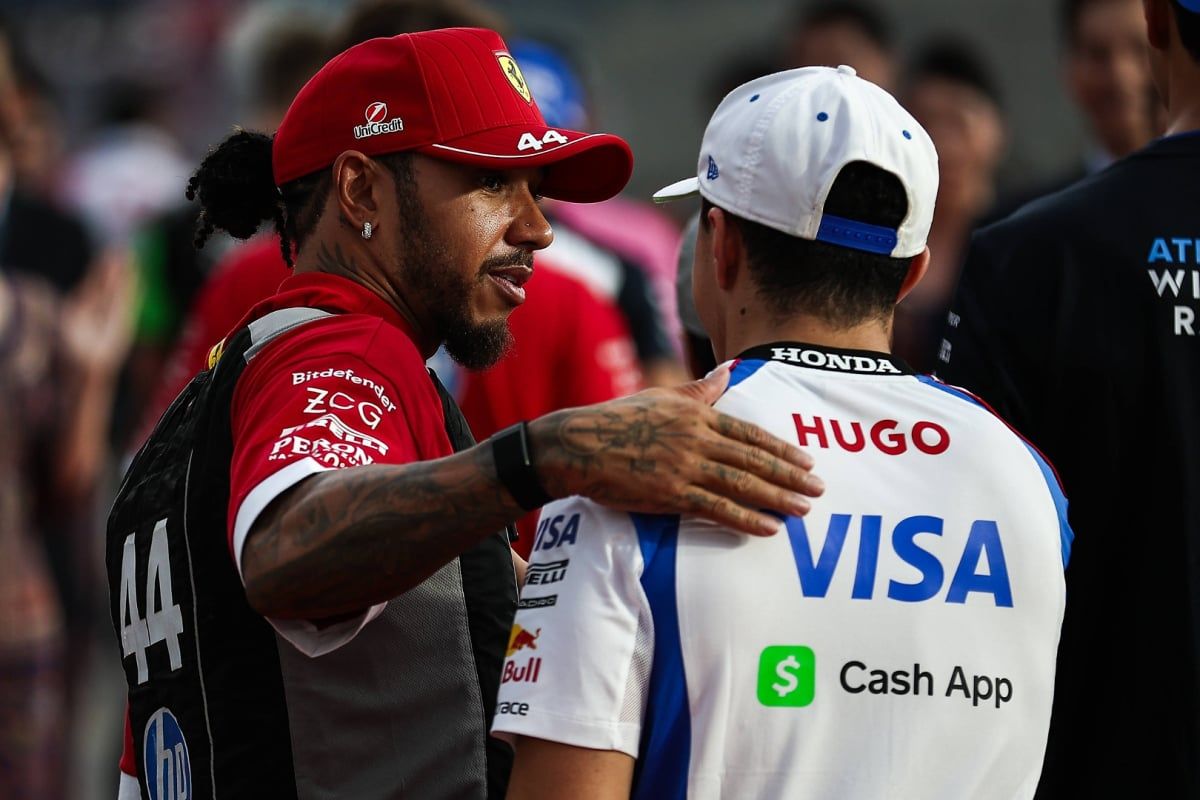
Lewis Hamilton Issues Strong Warning to Red Bull Over Isack Hadjar’s 2026 Promotion
Seven-time Formula 1 world champion Lewis Hamilton has raised serious concerns about Red Bull’s decision to promote young French-Moroccan driver Isack Hadjar to the senior team for the 2026 season. The confirmation, which arrived ahead of the season-ending Abu Dhabi Grand Prix, places the 21-year-old alongside Max Verstappen—an opportunity that many young drivers dream of, but which Hamilton believes has historically come with significant risks.
Hadjar, who currently competes for Racing Bulls, has enjoyed an impressive debut season in Formula 1, earning praise for his maturity, racecraft, and adaptability. However, his move up to the main Red Bull outfit will also see Yuki Tsunoda displaced from a full-time seat. Tsunoda, despite strong performances and fan support, will become Red Bull’s test and reserve driver for 2026. Meanwhile, rising talent Arvid Lindblad has been handed the chance to take Hadjar’s former seat at Racing Bulls.
Yet beneath the excitement of a young star moving up the ranks lies a troubling trend within the Red Bull driver program—a pattern Lewis Hamilton was quick to highlight. In recent years, several drivers who excelled at the junior team struggled to survive the overwhelming pressure, internal expectations, and Verstappen-centric environment of the main team. According to Hamilton, this history should not be ignored.
Over the past few seasons, Red Bull’s handling of its drivers has been widely questioned. Sergio Pérez, once hailed as the perfect teammate to Verstappen after strong 2022 and 2023 campaigns, was ultimately dropped. Liam Lawson was given a brief opportunity but was removed after only two races in 2025, with Tsunoda taking his place—only to find himself out again the following year. For many, Tsunoda’s demotion is seen as a potential end to his F1 future, highlighting the instability within the program.
This is the environment Hadjar is walking into—one Hamilton fears could derail a promising career if Red Bull doesn’t change its approach.
Speaking to the official F1 channel in Abu Dhabi, the Ferrari driver admitted that the announcement took him by surprise. “I literally only heard about it today,” he said. “And honestly, I’d be lying if I said I wasn’t worried.”
Hamilton was quick to acknowledge Hadjar’s talent, emphasizing that the rookie has impressed many throughout the paddock. “He’s had an incredible season and he’s still so young. He’s learning a lot about himself, the car, the sport. His mindset has been amazing, and he’s shown huge potential,” Hamilton said. But his praise came with a sharp warning: potential alone may not be enough to survive the Red Bull environment.
The British driver has repeatedly highlighted how challenging it can be for drivers who join teams built around a clear number one. Red Bull’s long-standing strategy of tailoring the car around Verstappen’s driving style is well-known, often leaving teammates struggling to adapt. For Hamilton, who has faced transitions himself—particularly this season with Ferrari—these challenges can be career-defining.
“We’ve all seen what happens when drivers move to Red Bull,” Hamilton continued. “I’ve never been inside that system, so I can’t speak from experience, but from the outside it looks extremely demanding. At Racing Bulls, he has what appears to be a supportive, stable environment. Going to the main team is a very different world.”
Hamilton’s concern isn’t limited to Hadjar alone. He pointed out that drivers like Tsunoda, Lawson, and even Pérez were all strong competitors, yet still faced the harsh consequences of Red Bull’s results-driven culture. “Yuki is a brilliant driver. So were several others who went through there. But we all know the general experience—many of those drivers don’t suddenly become worse. Clearly there is something deeper going on.”
The 40-year-old hopes Red Bull has learned from the past and will handle Hadjar differently. “I just really hope they give him the proper support,” he said. “If the environment evolves and if the team ensures he has what he needs, he could flourish. But if nothing changes, then there’s real danger his potential will be wasted.”
Hamilton’s comments reflect broader concerns in the F1 community about the sustainability of Red Bull’s driver management approach. As the sport enters a new era in 2026—complete with fresh regulations, new power units, and major team restructurings—how Red Bull manages its young drivers could play a major role in shaping the competitive landscape.
For now, Hadjar faces both a massive opportunity and one of the greatest challenges of his career. Whether he thrives or becomes another casualty of Red Bull’s high-pressure system remains to be seen.