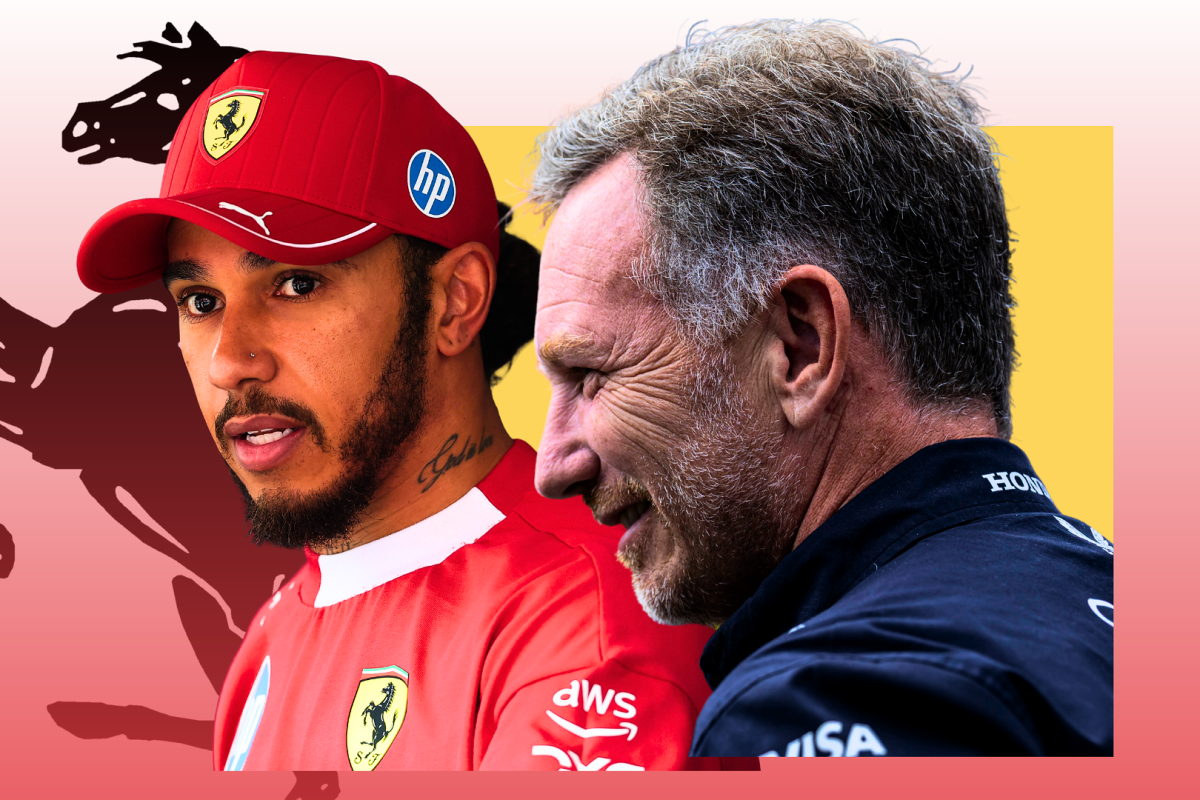
Lewis Hamilton Could Reconsider Ferrari Future if Christian Horner Takes Charge
Speculation around Christian Horner’s next move in Formula 1 continues to gather momentum, with Ferrari emerging as one of the teams reportedly considering the former Red Bull boss. While such an appointment would mark a major shake-up at Maranello, it could also have significant implications for one of the sport’s biggest names: Lewis Hamilton.
Horner has been without a role since his shock departure from Red Bull in July, ending a 20-year tenure that delivered six constructors’ championships and helped establish one of the most dominant eras in modern F1. Given Ferrari’s long-standing struggles to return to championship-winning form, his availability inevitably places pressure on current team principal Fred Vasseur.
Ferrari and Hamilton are already heading into a critical period. After a deeply disappointing 2025 campaign, both parties are targeting a reset in 2026, when sweeping technical regulation changes could dramatically alter the competitive landscape. For Hamilton, the goal is clear: return to race-winning and championship-contending form after a season that fell well below expectations.
The seven-time world champion endured one of the toughest years of his career in 2025. Driving the SF-25, Hamilton failed to secure a single grand prix podium and finished 86 points behind team-mate Charles Leclerc. Those results raised uncomfortable questions, not only about Hamilton’s adaptation to Ferrari, but also about the team’s overall direction under Vasseur’s leadership.
Ferrari’s decision to replace Carlos Sainz with Hamilton was made with the expectation of immediate impact, yet the reality proved far more difficult. As a result, scrutiny on Vasseur intensified throughout the season, and with Ferrari still without a championship since 2008, calls for change at the top have not gone away.
Against that backdrop, reports linking Horner to Ferrari have sparked debate about how Hamilton would respond if such a move were to happen. According to a recent Mail Sport column, Hamilton could even consider “walking out” on Ferrari should Horner be appointed as team principal.
The suggestion is rooted in several factors. Hamilton is known to share a strong personal and professional relationship with Vasseur, dating back to their time working together in Formula 2 in 2006. That history is believed to have played a role in Hamilton’s decision to join Ferrari in the first place. Replacing Vasseur could therefore unsettle a partnership built on trust and familiarity.
There is also the reality that Hamilton and Horner have clashed publicly on multiple occasions over the years, particularly during intense championship battles between Mercedes and Red Bull. Their relationship has rarely been warm, and that history naturally fuels speculation about whether Hamilton would welcome Horner’s presence at Ferrari.
Contractually, Hamilton’s future is already open-ended. His Ferrari deal is widely believed to run until the end of 2026, aligning with the new regulations. Should Ferrari opt to change team principals during that period, it could make a decision to move on—or even retire—easier for the Briton.
However, there is another side to the argument. Horner’s track record is undeniable. Few team principals in F1 history can match his success, and his ability to build championship-winning structures is precisely what Ferrari have lacked for more than a decade. From a purely competitive standpoint, Horner’s arrival could strengthen Ferrari’s long-term prospects.
Hamilton is, above all else, a fierce competitor. While personal relationships matter, his primary motivation remains performance. If Ferrari were to show genuine progress in 2026, particularly under a leadership structure capable of delivering titles, it is difficult to imagine Hamilton walking away purely on principle.
The 40-year-old knew from the outset that his move to Ferrari would be a long-term project rather than an instant fairytale. With new regulations offering a rare opportunity to reset the pecking order, 2026 represents a pivotal season—not just for Ferrari, but for Hamilton’s career as a whole.
Ultimately, Hamilton’s decision on whether to continue beyond 2026 is likely to depend less on who occupies the team principal’s office and more on what happens on track. If Ferrari deliver a competitive car and Hamilton feels capable of fighting for a record-breaking eighth world title, the temptation to stay will remain strong.
Whether Ferrari stick with Vasseur, turn to Horner, or pursue an entirely different option, the coming months could define the next chapter of Hamilton’s legacy—and possibly determine how, and when, one of the greatest drivers in F1 history chooses to step away.