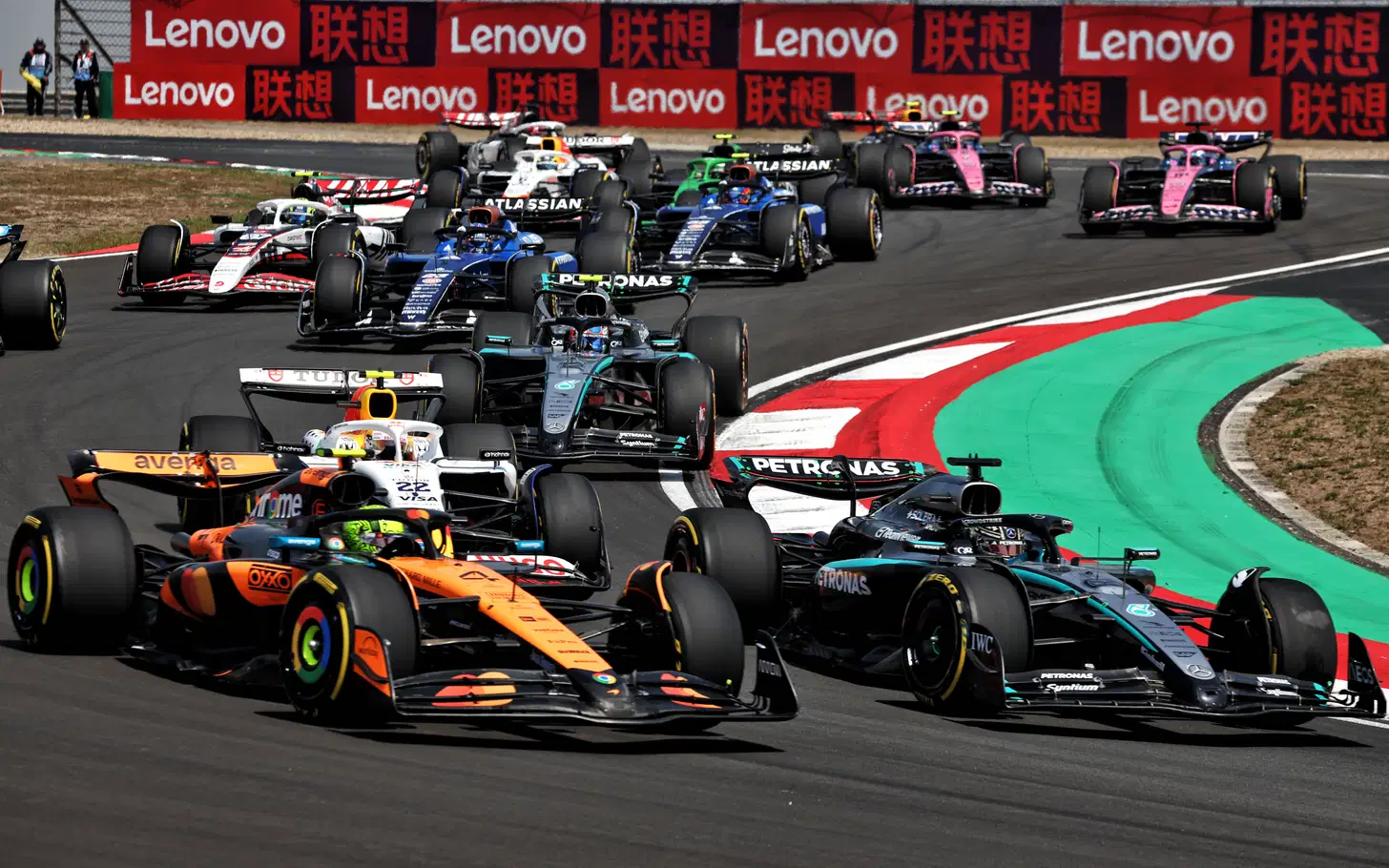
Lewis Hamilton Demands Answers as FIA Moves to Close Mercedes Engine Loophole
Seven-time world champion Lewis Hamilton has called on the Fédération Internationale de l’Automobile (FIA) to provide clarity over a controversial engine advantage linked to Mercedes-AMG Petronas Formula One Team after the German outfit displayed remarkable speed during the opening weekend of the Australian Grand Prix in Melbourne.
Mercedes arrived in Australia already widely considered one of the favourites for the 2026 season following a promising pre-season programme. Early testing and the January shakedown in Barcelona suggested the team had built a highly competitive package under Formula 1’s new regulations. That promise turned into a clear on-track statement at Melbourne’s Albert Park Circuit, where the Silver Arrows locked out the front row of the grid in dominant fashion.
Leading the charge was George Russell, who delivered a superb qualifying performance to secure pole position for the season opener. Russell set a blistering lap of 1:18.518 during the final stage of qualifying, edging his new teammate Kimi Antonelli by just under three-tenths of a second. However, the most striking detail was the significant gap between the Mercedes pair and the rest of the field, highlighting the impressive pace of their new challenger.
The team’s sudden dominance has also reignited debate surrounding a suspected technical innovation within Mercedes’ power unit design. According to speculation circulating in the paddock earlier this year, the manufacturer may have discovered a method of exploiting a grey area in the engine regulations concerning compression ratios.
Reports suggested the system allowed the engine’s geometric compression ratio to remain at the mandated 16:1 when the car was stationary—satisfying the FIA’s measurement procedures—but increase to the previously permitted 18:1 while the car was moving on track. Historically, the governing body measured this parameter only when the car was stationary and at ambient temperature, which some rival teams believed created an exploitable loophole.
The discovery sparked concern among competing power unit manufacturers, who quickly urged the FIA to examine the situation. After discussions between engine suppliers and the governing body, a decision was reached to close the potential loophole. From the Monaco Grand Prix onwards, teams will no longer be permitted to operate engines in a way that alters the compression ratio dynamically in the manner described.
Despite the ruling, Hamilton—now racing for Scuderia Ferrari—has questioned why stronger action was not taken earlier. The British driver, who spent more than a decade with Mercedes before switching teams, admitted he was surprised by the extent of his former team’s speed advantage in Melbourne.
During the final practice session on Saturday, Hamilton was heard over team radio expressing disbelief at Russell’s pace, asking where the Mercedes driver had suddenly found more than six-tenths of a second compared to the rest of the field.
Speaking afterward, Hamilton said he wanted a clearer explanation from the sport’s governing body regarding the engine discussion.
“What’s clear is that they didn’t reveal their full engine performance during any of the practice sessions,” Hamilton said. “There’s been a lot of talk about compression ratios, and they’ve obviously done a strong job with their engine, as have we.”
However, he added that the magnitude of the advantage raised questions in his mind.
“I want to understand why there appears to be two-tenths or more just through power in each sector,” Hamilton continued. “If it is related to the compression ratio discussion, I’d like to know why the FIA hasn’t acted sooner and what has been done to address it. And if it isn’t that—if it’s simply that their engine is stronger—then it means we need to improve our own performance.”
Hamilton’s comments reflect the intense scrutiny surrounding the first race of Formula 1’s new technical era. With sweeping regulation changes introduced for 2026, teams have explored a wide range of creative engineering solutions in search of a competitive edge.
However, some analysts have cautioned against assuming that Mercedes’ pace advantage is purely engine-related. Former strategist and F1 analyst Bernie Collins noted that several teams on the grid use Mercedes power units, yet their performance levels vary significantly.
“Four teams are running the Mercedes engine,” Collins explained during broadcast analysis. “If the advantage were entirely due to the compression ratio or engine power alone, we would expect those teams to dominate the top of the timesheets as well, and that isn’t what we’re seeing.”
Instead, she suggested that Mercedes’ performance advantage may stem from a combination of factors, including aerodynamic efficiency, chassis balance, and overall integration of the new regulations.
Regardless of the exact cause, the Melbourne weekend has already set the tone for a potentially dramatic 2026 season. Mercedes’ commanding qualifying display, combined with the controversy surrounding their power unit, ensures that both the team and the FIA will remain under intense scrutiny as the championship unfolds.
With the rules set to change again before the Monaco round, the coming races will reveal whether Mercedes can maintain their early dominance—or whether their rivals, including Hamilton and Ferrari, can close the gap and challenge the Silver Arrows for supremacy.