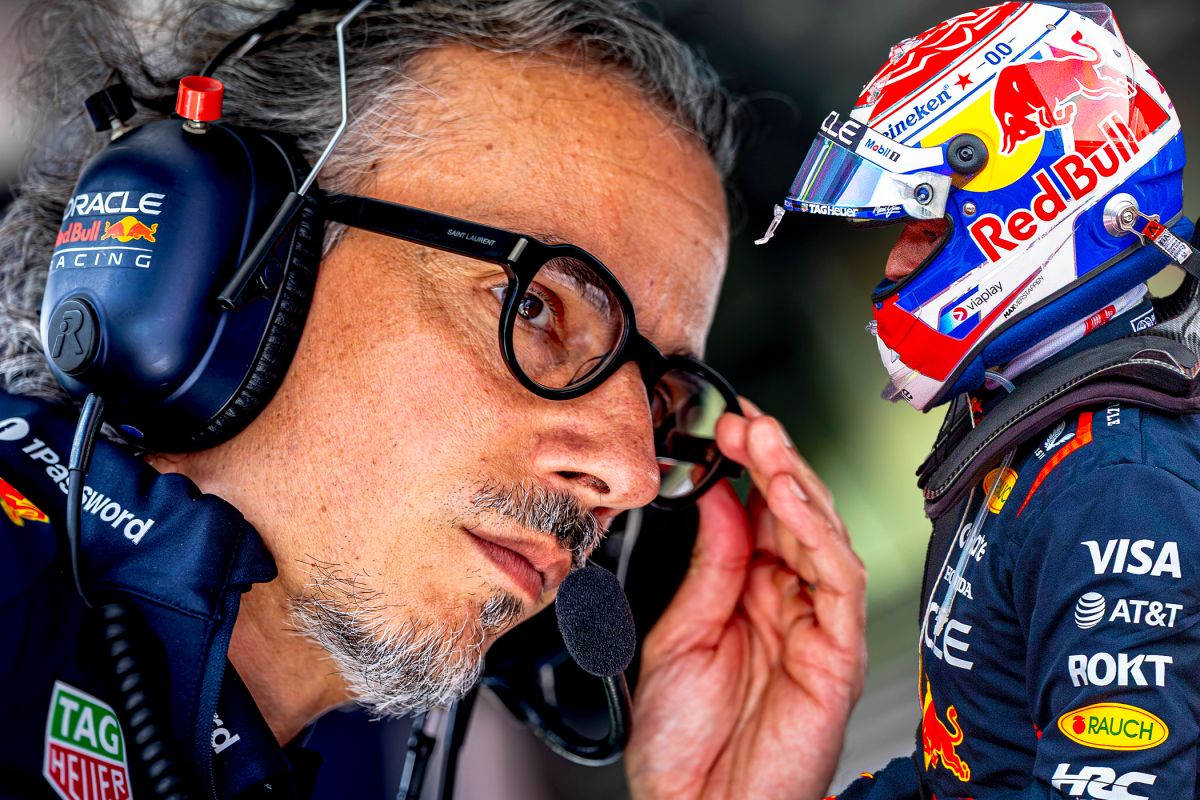
Max Verstappen Team-Mate Crisis at Red Bull Explained by Jacques Villeneuve
The ongoing struggles faced by drivers partnering Max Verstappen at Red Bull Racing have once again been placed under the spotlight, with former world champion Jacques Villeneuve offering a blunt and revealing assessment of the situation.
Since the start of 2024, Red Bull’s second seat has become one of the most unstable positions on the Formula 1 grid. Verstappen is set to have his fourth different team-mate in just two seasons when the 2026 campaign begins, underlining the depth of the issue. Neither Sergio Perez, Liam Lawson, nor Yuki Tsunoda were able to consistently operate at a level close enough to the Dutchman to secure long-term confidence from the team.
Red Bull recently confirmed that Isack Hadjar will step into the second seat for 2026, while Tsunoda has been reassigned to a test and reserve role. Meanwhile, highly rated junior Arvid Lindblad will move up to Racing Bulls, continuing the team’s aggressive driver development strategy.
The constant turnover has led many observers to describe the second Red Bull seat as a “poisoned chalice.” Questions have repeatedly been asked about whether the team’s cars are deliberately designed to suit Verstappen’s driving style, leaving anyone else at a disadvantage. However, Villeneuve has strongly rejected that narrative.
Speaking on the High Performance podcast, the 1997 world champion argued that the issue lies not with Red Bull’s engineering philosophy, but with Verstappen’s extraordinary ability to understand and evolve the car faster than anyone else.
According to Villeneuve, Verstappen is not simply benefiting from a car built around him. Instead, he is actively driving development forward, constantly refining the car through feedback and understanding that few drivers can match. As a result, while Verstappen improves, his team-mate often appears to go backwards by comparison.
Villeneuve explained that the performance gap widens over time because Verstappen continues to extract more from the car, while the second driver struggles to adapt to the increasingly precise operating window required. “It’s not that the second driver becomes slower,” Villeneuve noted. “It’s that Max keeps getting faster.”
This pattern was particularly evident during Sergio Perez’s time alongside Verstappen. Villeneuve pointed out that Perez often began seasons relatively close in performance, only to fall further behind as the year progressed. In Villeneuve’s view, this was not due to a sudden drop in Perez’s ability, but rather Verstappen’s superior capacity to interpret what the car was doing and how to fix its weaknesses.
Modern Formula 1 cars are notoriously complex, especially with the heavy reliance on aerodynamics and ultra-stiff suspension setups. Villeneuve highlighted how small differences in mechanical balance — such as front-end stiffness or understeer characteristics — can completely change how a car behaves. Understanding whether a problem is caused by aero balance, ride height, or mechanical grip is critical, and Verstappen excels in this area.
He also explained that today’s ground-effect cars require teams to run extremely stiff setups to maximise aerodynamic performance. While this produces huge downforce, it also makes the car harder to drive mechanically. Only a handful of drivers are capable of finding the narrow “sweet spot” where the car delivers peak performance without becoming unpredictable.
Villeneuve described Verstappen as one of those rare drivers who can reach a point where the car feels like an extension of his body — a level of harmony that allows him to push without consciously thinking about the limits. Drivers who cannot reach that level are left chasing a moving target, as Verstappen and the engineers continue refining the package around his feedback.
As Hadjar prepares to step into one of the most demanding roles in Formula 1, Villeneuve’s comments serve as both a warning and an explanation. The challenge at Red Bull is not simply about speed, but about technical understanding, adaptability, and mental resilience. Unless a driver can grow alongside Verstappen, the cycle that has defined Red Bull’s second seat may be destined to repeat itself once again.