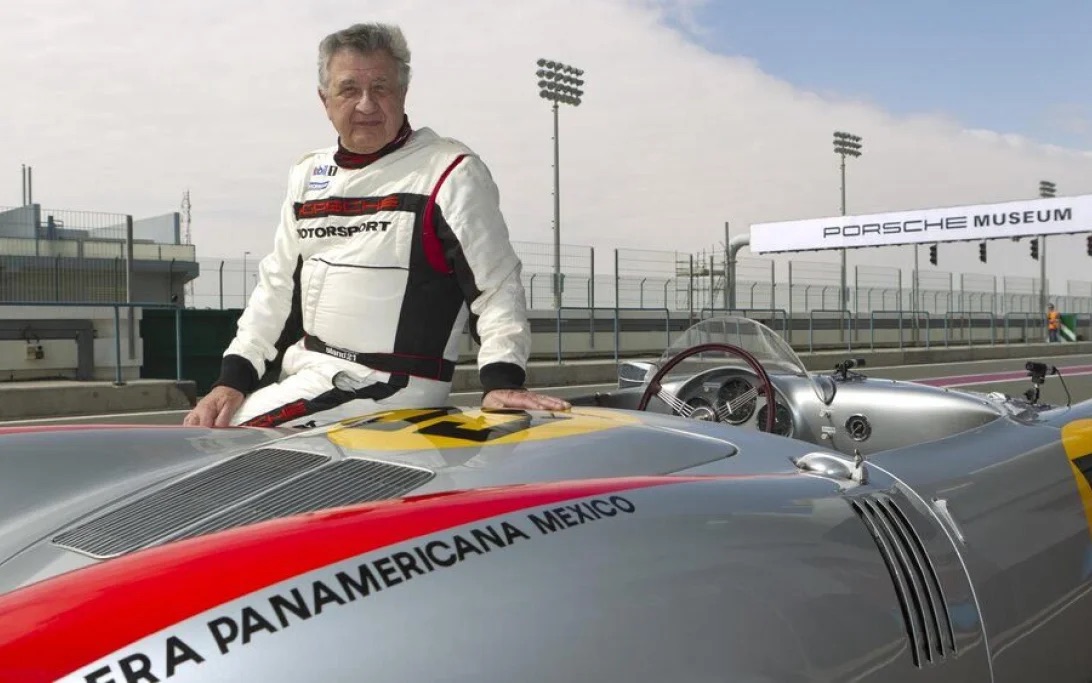
Porsche and Motorsport Mourn the Loss of Racing Icon Hans Herrmann at 97
The world of motorsport is mourning the loss of one of its true pioneers following the death of Hans Herrmann, the legendary German racer who played a foundational role in Porsche’s racing history. Herrmann, Porsche’s first overall winner of the 24 Hours of Le Mans and the last surviving Formula 1 podium finisher from the 1950s, passed away at the age of 97.
The heartbreaking news was confirmed by Porsche on Friday evening, casting a shadow over what was meant to be a celebratory weekend for the German manufacturer. The announcement came just ahead of the Mexico City E-Prix, where Porsche had already unveiled a special commemorative livery designed to honour Herrmann’s extraordinary contribution to motorsport.
This weekend’s Formula E race at the Autódromo Hermanos Rodríguez also marks the opening chapter of Porsche’s year-long celebration of 75 years in motorsport. Few figures symbolise the brand’s racing origins more authentically than Herrmann, whose career intertwined with Porsche’s earliest international successes.
The special livery revealed in Mexico pays tribute to the iconic Porsche 550 Spyder, the car that carried Herrmann to a class victory at the gruelling 1954 Carrera Panamericana. That legendary Mexican road race remains one of the most dangerous and storied events in motorsport history, and Herrmann’s success there helped cement Porsche’s reputation on the global stage.
Born in Stuttgart, Herrmann’s journey into racing was anything but conventional. A baker by trade in his early years, he discovered his talent behind the wheel in the early 1950s, rapidly rising through the ranks at a time when motorsport demanded not just skill, but immense bravery. In 1953, he made his debut in both Formula 1 and endurance racing, entering an era where safety was minimal and risk was ever-present.
Herrmann went on to start 18 Formula 1 Grands Prix during his career, representing teams such as Mercedes at a time when the famous Silver Arrows were redefining the sport. His most notable F1 achievement came at the 1954 Swiss Grand Prix, where he finished third behind the wheel of a Mercedes. That result earned him a place on the podium and, decades later, a unique place in history.
Following the death of fellow British racer Tony Brooks in 2022, Herrmann became the last living driver to have stood on a Formula 1 podium during the 1950s. His passing now closes an extraordinary chapter from the sport’s earliest and most perilous years.
Although Formula 1 showcased his versatility, it was in sports car racing where Herrmann truly built his legacy. His name became synonymous with Porsche’s rise in endurance racing, culminating in one of the most significant victories in the manufacturer’s history. In 1970, alongside teammate Richard Attwood, Herrmann secured Porsche’s first overall victory at the 24 Hours of Le Mans — a triumph that laid the foundation for the brand’s future dominance at the iconic French endurance classic.
That Le Mans win was particularly poignant, coming after years of near misses and personal setbacks. Herrmann had famously retired from racing once before, citing the dangers of the sport, only to return and achieve the ultimate success with Porsche on the world’s biggest endurance stage.
His final Formula 1 appearance was scheduled for the 1969 German Grand Prix, though he was ultimately withdrawn from the event due to concerns over a potential suspension or steering failure. Soon after, Herrmann brought an end to his competitive racing career, leaving behind a résumé that spanned nearly two decades and multiple disciplines.
Porsche described Herrmann as a driver of courage, humility, and immense importance to its motorsport heritage. His influence extended far beyond trophies and statistics — he was a symbol of perseverance, technical understanding, and fearlessness during racing’s most unforgiving era.
As Porsche embarks on its 75th anniversary celebrations, the absence of Hans Herrmann will be deeply felt. Yet his legacy lives on in every Porsche that lines up on a starting grid, from Le Mans to Formula E. Motorsport has lost not just a champion, but a living bridge to its earliest days — a man whose life story mirrored the evolution of racing itself.