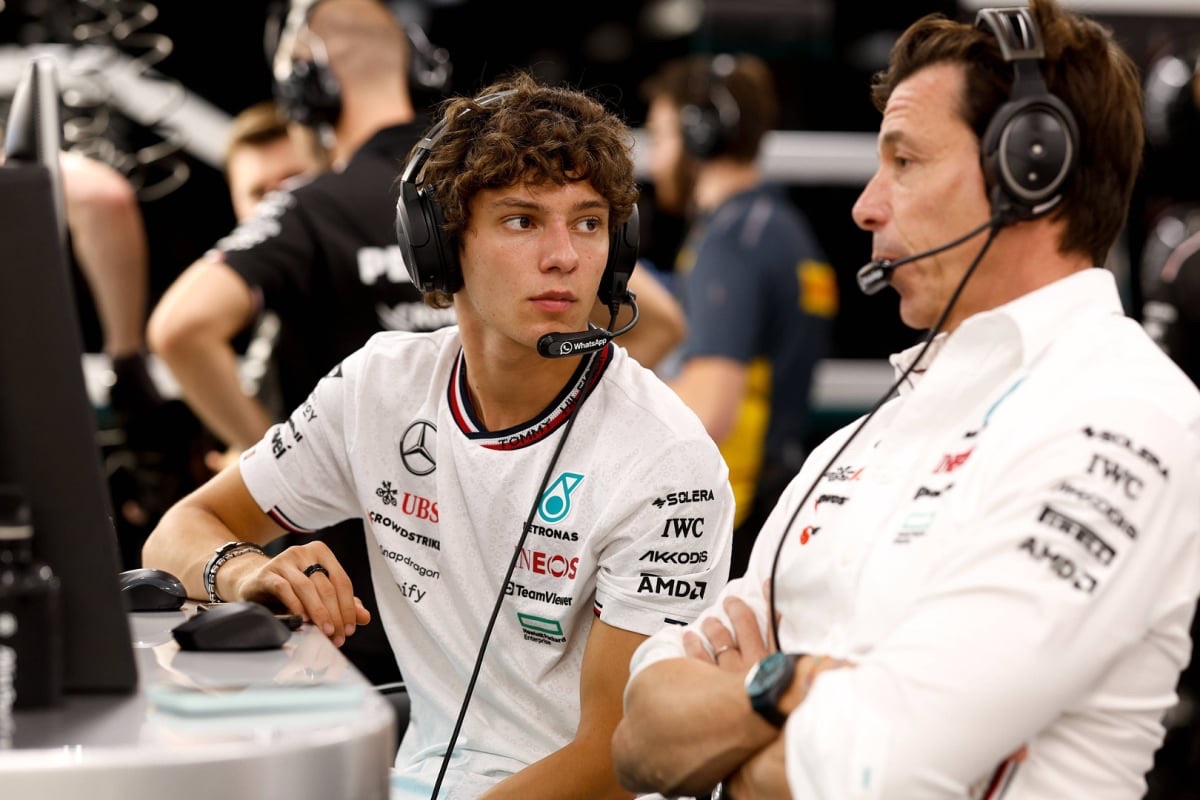
Toto Wolff has come under scrutiny following comments made after Kimi Antonelli secured his maiden Formula 1 victory, with former team boss Guenther Steiner accusing the Mercedes chief of turning the moment into an exercise in self-justification.
Antonelli, just 19 years old, delivered a landmark performance at the Chinese Grand Prix, leading a dominant Mercedes one-two finish ahead of teammate George Russell. The victory marked a significant breakthrough for the young Italian, who had endured a challenging debut season in 2025 despite showing flashes of promise.
During his rookie campaign, Antonelli managed three podium finishes but ultimately struggled for consistency. He ended the season far behind Russell in the standings, trailing by a substantial margin of 169 points. A particularly difficult mid-season European stretch saw him collect just three points, with modest finishes including ninth place at the Italian Grand Prix and tenth in Hungary. These struggles, combined with an earlier crash during his first Formula 1 outing in free practice in 2024, led many critics to question whether Wolff had promoted Antonelli to Mercedes too soon, especially as a replacement for Lewis Hamilton.
Those criticisms appeared to linger in Wolff’s mind. Following Antonelli’s victory in Shanghai, the Mercedes boss delivered a pointed and somewhat sarcastic message over team radio, seemingly aimed at detractors. In his remarks, Wolff mimicked earlier criticisms, saying: “He’s too young. We shouldn’t put him in a Mercedes. Put him in a smaller team. He needs experience. Look at the mistakes he makes.” He then concluded triumphantly, celebrating Antonelli’s win as validation of his decision.
However, Steiner was unimpressed by Wolff’s reaction. Speaking on the Red Flags podcast, the former Haas team principal argued that Wolff’s comments were unnecessary and shifted attention away from the driver’s achievement. Steiner suggested that the Mercedes boss was more focused on proving his critics wrong than simply celebrating Antonelli’s success.
According to Steiner, Wolff’s message came across as “self-promotion,” implying that he was eager to highlight his own judgment rather than letting the result speak for itself. He questioned why Wolff felt the need to emphasize that he had made the right call, noting that Antonelli’s performance alone was enough to silence doubts. Steiner also hinted that Wolff might be carrying a “complex” about the criticism he received when promoting the young driver, suggesting that the reaction revealed lingering sensitivity.
Steiner further stressed that while team principals play a key role in nurturing talent, the credit for success ultimately belongs to the driver. In his view, Antonelli’s victory should have been allowed to stand on its own merit without being framed as a vindication of management decisions.
Despite the controversy, Antonelli’s win has significantly boosted his standing within the championship. The Italian now sits second in the drivers’ standings, just four points behind Russell, as Mercedes enjoy a perfect start to the 2026 season with back-to-back one-two finishes. Russell himself opened the campaign with victory at the Australian Grand Prix, underlining the team’s early dominance.
Attention now turns to the next round of the championship, the Japanese Grand Prix, scheduled for Sunday, March 29. Mercedes will be aiming to continue their winning streak at Suzuka, a circuit where they have not triumphed since 2019, when Valtteri Bottas took victory.
However, the competition is expected to intensify, with Ferrari drivers Lewis Hamilton and Charles Leclerc poised to challenge Mercedes’ early supremacy. As the season gathers momentum, Antonelli’s breakthrough win—and the debate surrounding Wolff’s reaction—has added another compelling layer to an already intriguing championship battle.