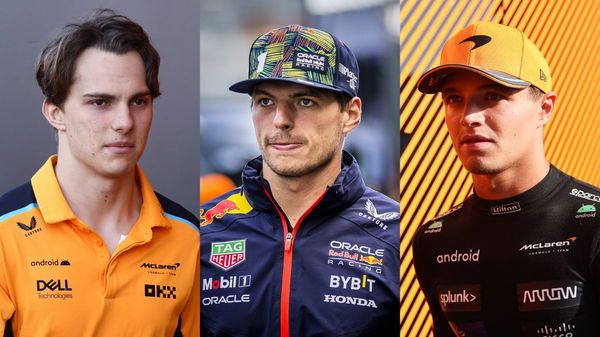
Verstappen: Clear Driver Hierarchy Is the Key to Winning Titles
Max Verstappen has made his views unmistakably clear: if he were running a Formula 1 team, there would be no ambiguity about who leads it. The four-time world champion has questioned McLaren’s decision to avoid naming a clear number one driver, arguing that the team’s equal-treatment approach ultimately worked against them in their battles at the front of the grid.
Throughout recent seasons, McLaren have insisted on giving Lando Norris and Oscar Piastri equal status, allowing them to race freely under the so-called “Papaya Rules.” While the philosophy was praised for fairness, Verstappen believes it came at a competitive cost, particularly in tight championship fights where decisive strategy calls can make the difference.
By contrast, Verstappen has long enjoyed undisputed number-one status at Red Bull Racing. The Dutchman has been the focal point of the Milton Keynes outfit’s strategy, car development, and race execution, with the team consistently shaping its approach around maximizing his championship chances. According to Verstappen, that clarity has been one of Red Bull’s biggest strengths during its dominant era.
It must be acknowledged, however, that Red Bull’s decision-making was often straightforward. Verstappen has rarely had a teammate capable of consistently matching his pace over a full season. That reality naturally reinforced his position as team leader, whereas McLaren faced a more complex scenario with Norris and Piastri delivering closely matched performances.
Red Bull’s history supports Verstappen’s argument. The team has traditionally operated with a defined hierarchy, dating back to the Sebastian Vettel–Mark Webber era. Vettel was clearly established as the lead driver and went on to deliver four consecutive world titles. Webber challenged that status at times, but Red Bull remained firm in its structure, prioritizing Vettel’s championship campaigns.
The only period of genuine internal tension came when Verstappen was paired with Daniel Ricciardo. Their rivalry intensified in 2018 and reached a boiling point with their infamous collision at the Azerbaijan Grand Prix. Even then, Red Bull ultimately sided with Verstappen, a decision Ricciardo interpreted as a sign that his long-term prospects within the team were limited. He subsequently departed for Renault and later McLaren.
In more recent seasons, Verstappen has often found himself fighting alone at the front. Sergio Perez struggled for consistency during the 2024 campaign, while his replacements failed to provide meaningful support. Liam Lawson, promoted for 2025, lasted just two races, and Yuki Tsunoda was also unable to play a significant role in backing up Verstappen’s title efforts.
Yet Verstappen insists that operating without a strong supporting teammate does not bother him. In fact, he argues that being the sole focal point of a team can be an advantage. “When you’re on your own, you can go on the attack, you can be much more aggressive,” he explained. “I always prefer that.”
He added that McLaren’s internal balance may have inadvertently helped Red Bull keep championship fights alive longer than expected. With Norris and Piastri frequently splitting points and sometimes compromising each other through strategy, Verstappen and Red Bull were able to capitalize, even when they did not have the outright fastest car.
“If I were a team boss, I would always put a clear number one and two in place,” Verstappen said. “Of course, a number two who still scores enough points to fight for the constructors’ championship. But it has to be clear. Because McLaren had two drivers, they gave away some things strategically, and we benefited from that.”
His comments carry added weight given recent title battles. Verstappen successfully fended off Norris to secure the 2024 championship, but the margins grew tighter as McLaren’s competitiveness increased. In 2026, even Verstappen’s resilience and talent were not enough to overcome the combined strength of McLaren’s package, as he narrowly lost the drivers’ title to Norris by just two points.
That season saw Verstappen produce a remarkable mid-year recovery, overturning a 104-point deficit to force the championship fight down to the wire. Despite the loss, his comeback reinforced his belief that clarity of leadership within a team remains crucial when titles are on the line.
As Formula 1 continues to debate the merits of equal driver treatment versus firm hierarchies, Verstappen’s stance is unambiguous. In his view, championships are not won through diplomacy but through decisiveness—and that starts with knowing exactly who your number one driver is.