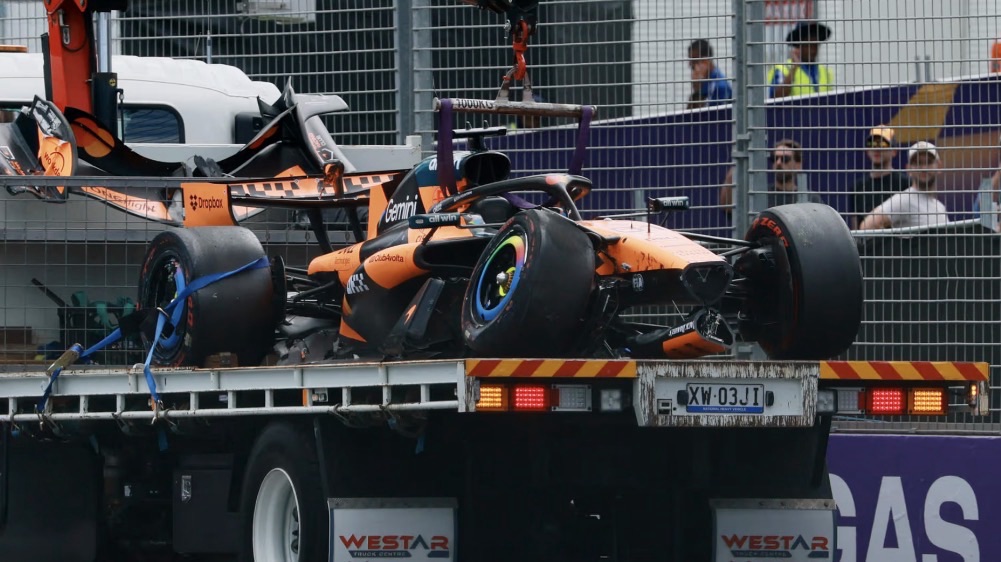
The start of the Formula 1 season at the Australian Grand Prix turned into a heartbreaking moment for Australian driver Oscar Piastri, whose race ended before it even officially began. The McLaren driver suffered a dramatic crash during the reconnaissance lap as he was making his way to the starting grid at Melbourne’s Albert Park Circuit. After the incident, Piastri explained that the crash was not caused by a single mistake but rather by several unfortunate circumstances that occurred simultaneously, describing it as a “combination of bad factors.”
Piastri had shown promising pace throughout the weekend and managed to secure a strong fifth-place starting position during qualifying. Expectations were high for the young Australian, especially since he was racing in front of his home crowd. Fans had gathered in large numbers to support him, hoping he would deliver an impressive performance at his home Grand Prix. However, those hopes quickly faded when the unexpected accident occurred even before the race had started.
The crash happened while Piastri was completing the reconnaissance lap—a routine lap drivers take before lining up on the starting grid. During this lap, drivers typically warm up their tyres and brakes while familiarizing themselves with track conditions. Unfortunately for Piastri, things went wrong at the exit of Turn 4. As he accelerated out of the corner, he lost control of his McLaren and slid into the wall, causing significant damage to the front of the car. The damage was severe enough that the team had no option but to withdraw the car, forcing Piastri out of the race immediately.
After the crash, Piastri spoke to the media to explain what had happened. According to him, the incident was triggered by a series of factors that combined in a very unfortunate way. He mentioned that he had placed his car slightly onto the exit kerb at Turn 4. While using the kerb is common and something he had done throughout the weekend without issue, it became problematic in this particular moment.
At the same time, Piastri experienced an unexpected surge of power from the engine. He revealed that when he shifted gears at that moment, the car suddenly delivered approximately 100 kilowatts more power than he had been experiencing during the rest of the weekend. This sudden increase in power caused the rear wheels to spin, especially since the car was already partly on the kerb. The combination of the extra power and the reduced grip caused the car to snap into a spin almost instantly.
The unexpected wheelspin meant that Piastri had very little time to react. He explained that the car spun so quickly that he was already facing the wrong direction before he could take corrective action. In racing, moments like this happen in fractions of a second, and even highly skilled drivers often cannot recover once the car loses traction in such circumstances. As a result, the McLaren slid across the track and collided with the concrete barrier.
Another factor that contributed to the crash was the condition of the tyres. Because it was only the reconnaissance lap, the tyres had not yet reached their optimal operating temperature. Cold tyres provide less grip, making it easier for the car to lose control when sudden power is applied. Piastri acknowledged that this played a role in the incident and admitted that part of the responsibility rested with him as the driver.
In fact, the Australian driver was candid in accepting his share of the blame. He explained that he did not necessarily need to drive over the exit kerb at that moment, even though he had done so many times earlier in the weekend. In hindsight, avoiding the kerb might have reduced the risk of losing control. Still, he emphasized that the unexpected power spike was also a significant contributing factor that made the situation harder to manage.
What made the situation even more frustrating for Piastri was that the car itself had not malfunctioned. From the team’s perspective, everything had been operating within the rules and functioning normally. The sudden increase in power was related to the way the hybrid power unit system operates under current regulations, rather than a mechanical failure or technical fault. This meant that while the behavior of the car was technically normal, it still caught the driver off guard at a critical moment.
Piastri admitted that it would have been easier to accept the incident if it had been purely a driver error caused by cold tyres or overconfidence. Instead, the presence of multiple contributing factors made the situation more difficult to process. The combination of driver input, track positioning, tyre temperature, and unexpected engine power created the perfect conditions for the crash to occur.
The emotional impact of the incident was significant for Piastri, particularly because it happened at his home race in Australia. Competing in front of a home crowd is a special moment for any driver, and the Australian Grand Prix was expected to be one of the highlights of his season. Being forced to retire before the race even began was therefore deeply disappointing.
Piastri openly expressed how upsetting the situation was, saying it hurt a great deal to miss the chance to race in front of the fans who had come out to support him. He apologized to those supporters, acknowledging that the outcome was far from what he had hoped for. The young driver emphasized that this was not the way he wanted to start the new Formula 1 season.
With Piastri unable to start the race, his teammate Lando Norris became the only representative for McLaren on the grid. Norris went on to complete the race and finished in fifth place. Meanwhile, the race itself was won by George Russell driving for Mercedes-AMG Petronas Formula One Team, with teammate Kimi Antonelli finishing second and Charles Leclerc taking third place.
Although the accident was a disappointing start to the season, Piastri and his team will analyze the data carefully to understand the precise sequence of events that led to the crash. Formula 1 teams routinely perform detailed post-race reviews to ensure that lessons are learned and similar incidents can be avoided in the future.
For Piastri, the focus will now shift to the upcoming races on the calendar. While the Australian Grand Prix ended in frustration, the season is still long, and the McLaren driver will have many more opportunities to demonstrate his pace and competitiveness as the championship continues.