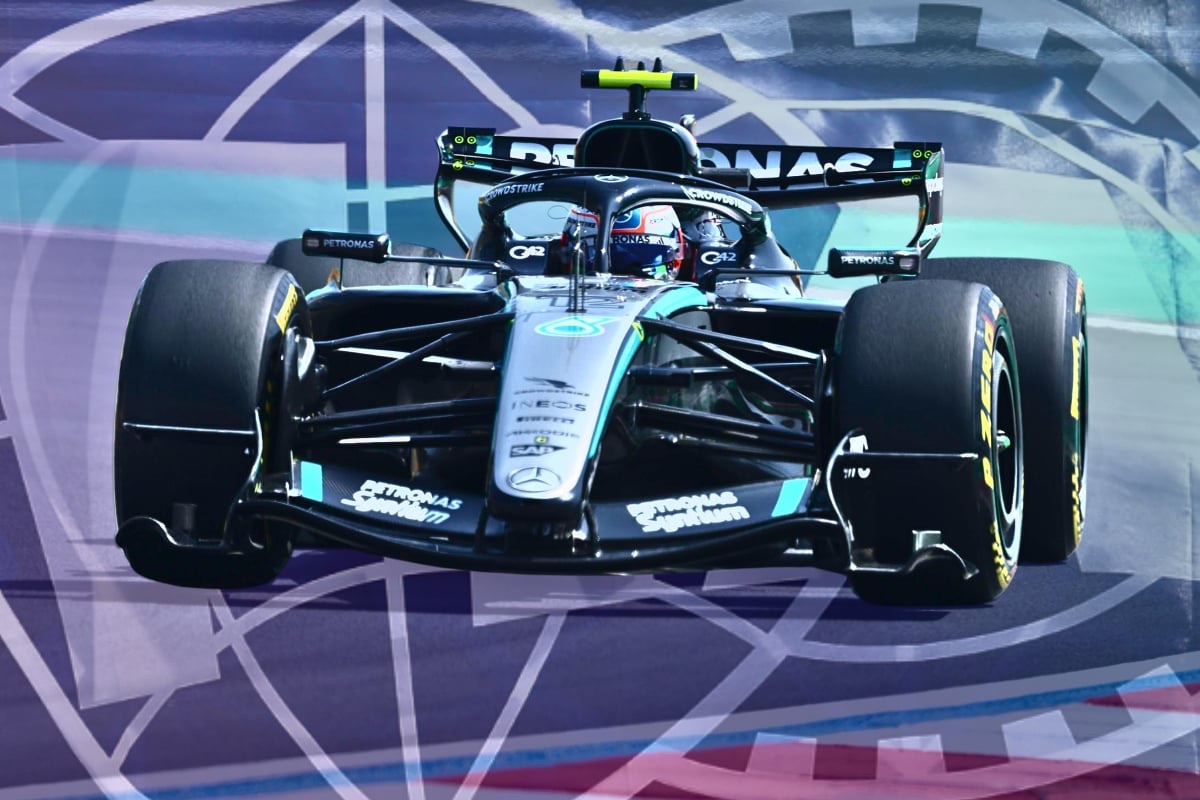
Mercedes could find themselves on the receiving end of an indirect Formula 1 “punishment” after the FIA confirmed major regulation adjustments for the future of the sport. While the Silver Arrows currently sit comfortably at the top of the 2026 grid, the governing body’s latest decisions could threaten their advantage in the years ahead.
The 2026 season has so far belonged entirely to Mercedes. The team has dominated both championships, building a commanding 70-point lead in the constructors’ standings while their drivers continue to control the title battle. Rookie sensation Kimi Antonelli currently leads teammate George Russell after securing three consecutive victories.
However, sweeping technical changes introduced by the FIA could reshape the competitive landscape. The sport had originally planned for the 2026 power unit regulations to feature an equal 50-50 balance between electrical energy and internal combustion power. But concerns over excessive battery management and energy efficiency have pushed the FIA to rethink that direction.
From 2027 onward, Formula 1 engines are now expected to operate closer to a 60-40 split in favour of the combustion engine. The adjustment is designed to reduce the heavy reliance on electrical deployment that teams and drivers have struggled with under the current concept. Drivers have frequently been forced into extreme lift-and-coast techniques to preserve battery energy during races, something the FIA believes has negatively affected the spectacle.
According to Sky Sports F1 presenter Naomi Schiff, the FIA would have fully understood the possible consequences for Mercedes before approving the changes. Speaking on the “Up to Speed” podcast, Schiff explained that there is a strong political dimension behind the decision because Mercedes currently possesses the benchmark engine package on the grid.
She suggested some observers could view the regulation shift as a move that potentially limits a new Mercedes era of dominance before it truly begins. At the same time, she stressed that the FIA’s concerns are rooted in practicality, particularly the inefficiency of the current battery systems.
Schiff explained that increasing the proportion of combustion power would reduce the burden on drivers to constantly manage energy usage. But the change also creates a major engineering challenge. More reliance on fuel means teams may need to redesign their fuel cells, and that could trigger significant alterations to the overall chassis concept.
The timing of the FIA’s intervention is another major concern. Most teams are already deep into the design phase for next season’s machinery, with wind tunnel development deadlines rapidly approaching. Any dramatic shift in technical requirements at this stage could force teams back to the drawing board and disrupt months of planning.
Despite the upcoming rule changes, Mercedes remain overwhelming favourites to continue their dominance throughout 2026. No rival team has yet shown the pace needed to consistently challenge them, leaving the championship fight largely confined to Antonelli and Russell.
Still, another FIA clarification arriving before the Monaco Grand Prix may slightly reduce Mercedes’ advantage. From June 1, 2026, Formula 1 officials will begin measuring engine geometric compression ratios not only at ambient temperature but also when the engine reaches 130 degrees Celsius.
The revision directly impacts a clever solution Mercedes had reportedly exploited within their power unit design. Under the previous interpretation of the regulations, the team could maintain the permitted 16:1 compression ratio when the car was stationary, while the ratio would reportedly increase to the previously allowed 18:1 once the engine was operating under racing conditions.
Because earlier rules only required measurements at ambient temperature, Mercedes were able to benefit from the loophole legally. The FIA’s revised testing procedure effectively closes that gap.
The change could offer rivals such as Ferrari and Red Bull Racing renewed hope of reducing the performance deficit to Mercedes during the remainder of the season.
While Mercedes still appear firmly in control for now, the FIA’s latest interventions have introduced uncertainty into what once looked like the beginning of another long-lasting Silver Arrows dynasty.