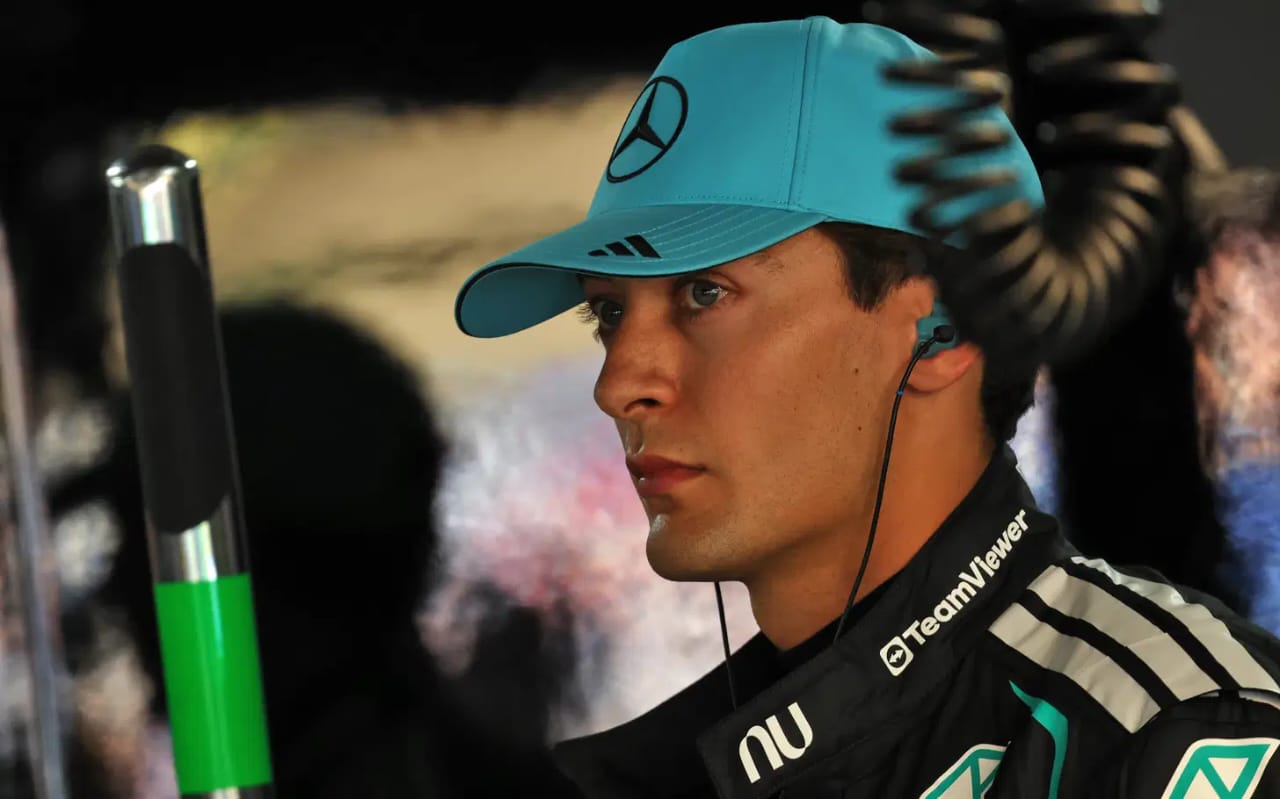

Mercedes driver George Russell has openly expressed his confusion and concern over what he describes as a puzzling and frustrating drop in performance from his team, as the Formula 1 season continues to unfold with increasing unpredictability. The British driver, who has often been one of the most consistent performers on the grid, admitted that neither he nor the team can clearly explain why the car’s pace appears to have regressed so dramatically in certain conditions.
Russell’s remarks come amid a challenging phase for Mercedes, a team that once dominated the sport but now finds itself struggling to match the consistent front-running pace of rivals such as Red Bull, Ferrari, and McLaren. While there have been flashes of competitiveness, these moments have been inconsistent, leaving both drivers and engineers searching for answers.
At the heart of Russell’s frustration is the apparent unpredictability of the car’s behavior. On some weekends, the Mercedes machine shows promising speed and balance, hinting that it can compete at the sharp end of the grid. Yet, on other occasions, that same car seems to lose competitiveness almost inexplicably. This inconsistency has made it extremely difficult for the team to build momentum or confidently develop upgrades.
Russell has indicated that this sudden drop-off in performance is not only confusing but also deeply concerning. In Formula 1, where fractions of a second can separate victory from midfield obscurity, understanding the car’s characteristics is crucial. When that understanding is lacking, it becomes nearly impossible to make effective adjustments or improvements.
This is not the first time Russell has raised concerns about Mercedes’ technical direction. In previous races, he has described the car as unpredictable and difficult to handle, even labeling it as one of the most inconsistent machines the team has ever produced . Such comments highlight a recurring theme: the team’s struggle to find a stable and reliable performance window.
One of the key issues appears to be how sensitive the car is to setup changes and track conditions. Even minor adjustments can lead to significant swings in performance, making it hard for the team to strike the right balance. This sensitivity has been particularly evident during race weekends where the car performs well in practice or qualifying, only to lose pace dramatically during the race itself.
Russell’s confusion is compounded by the fact that the team has already invested heavily in upgrades and development. In Formula 1, upgrades are expected to bring measurable improvements, but in Mercedes’ case, some changes have either failed to deliver the expected gains or have even made the car more difficult to drive. This has led to a situation where progress is not only slow but sometimes appears to be moving in the wrong direction.
The British driver has also pointed out that the problem is not always linked to obvious factors such as weather conditions or track layout. In some instances, the car has underperformed even in scenarios that should theoretically suit its characteristics. This makes diagnosing the issue even more complex, as there is no clear pattern to follow.
Historically, Mercedes has been known for its engineering excellence and ability to quickly solve problems. However, the current situation suggests that the team is dealing with deeper, more fundamental challenges. These could be related to aerodynamics, tyre management, or the overall concept of the car—areas that are notoriously difficult to fix quickly within the constraints of modern Formula 1 regulations.
Tyre performance, in particular, has been a recurring concern. Russell has previously noted how tyre degradation and overheating can dramatically affect race pace, sometimes causing the car’s performance to “fall off a cliff” during longer stints . When tyres cannot be kept in the optimal operating window, even the fastest car can struggle to maintain competitiveness.
Another factor that may be contributing to Mercedes’ struggles is the fine margins that define modern Formula 1. As Russell himself has acknowledged in the past, the differences between teams are often incredibly small, meaning that even a slight miscalculation in setup or strategy can have a significant impact on results . This level of competition leaves little room for error and amplifies any underlying weaknesses.
Despite these challenges, Russell has remained relatively composed and focused. Rather than placing blame, he has emphasized the importance of understanding the root cause of the problem. His approach reflects a broader mindset within the team: a determination to analyze, learn, and ultimately overcome the difficulties they are facing.
However, time is a critical factor. In a fast-moving championship battle, prolonged struggles can quickly derail a season. While Mercedes continues to search for answers, rival teams are constantly improving, making it even harder to close the gap.
The situation also raises broader questions about the team’s long-term direction. If the current issues stem from fundamental design choices, it may require a more significant overhaul to return to the front of the grid. Such changes are not easy to implement mid-season, which means the team may have to balance short-term fixes with long-term development strategies.
For Russell, the uncertainty is undoubtedly frustrating, especially given his ambition to compete for race wins and championships. As a driver who thrives on consistency and precision, dealing with an unpredictable car presents a unique challenge. Yet, it also highlights his resilience and determination to push forward despite the setbacks.
Ultimately, Russell’s comments underline a key reality in Formula 1: success is never guaranteed, and even the most dominant teams can find themselves facing unexpected difficulties. Mercedes’ current struggles serve as a reminder of how complex and competitive the sport has become.
As the season progresses, all eyes will be on whether Mercedes can unlock the answers to their performance puzzle. For now, however, Russell’s candid admission captures the mood within the team—a mix of confusion, concern, and a relentless drive to figure out what has gone wrong and how to put it right.