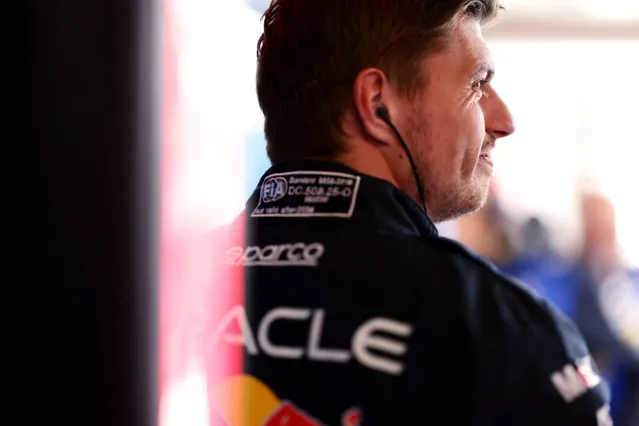

Ahead of another crucial Formula One weekend, Red Bull Racing made a late adjustment to Max Verstappen’s car in a move that immediately attracted attention across the paddock. The reigning world champions are continuing to search for every possible advantage as competition at the front of the grid becomes increasingly intense. With rivals such as Ferrari, McLaren, and Mercedes making steady progress, Red Bull’s decision highlighted both the pressure of the current championship fight and the team’s determination to remain at the top.
The modification to Verstappen’s RB machine reportedly came shortly before an important session, underlining the urgency behind the team’s decision-making. In modern Formula One, even the smallest setup alteration can have a major impact on performance, tyre management, balance, and overall race pace. Teams constantly evaluate data gathered from practice sessions, simulator work, and driver feedback before implementing changes that could unlock additional speed.
For Red Bull, the timing of the adjustment suggested that engineers had identified an area requiring immediate attention. Verstappen, known for his precise technical feedback and aggressive driving style, has often played a central role in helping the team fine-tune the car. His ability to communicate exactly what the car needs has been one of the strengths behind Red Bull’s dominance in recent seasons.
The Dutch driver has consistently demanded a car that provides a sharp front-end response while maintaining stability at high speed. However, Formula One cars operate within extremely narrow performance windows, meaning conditions such as track temperature, tyre degradation, wind direction, and circuit layout can dramatically alter competitiveness from one session to another. As a result, teams are frequently forced into last-minute decisions in an attempt to maximize performance.
Reports surrounding the change indicated that Red Bull’s engineers were focused on improving overall balance and drivability. While the exact technical details were not fully disclosed, such modifications often involve suspension settings, aerodynamic adjustments, ride height changes, or cooling configurations. Each of these elements can significantly influence how the car behaves over a race distance.
In recent races, Red Bull has faced stronger resistance from its competitors than it did during its period of overwhelming dominance. McLaren, in particular, has emerged as a genuine threat after introducing a series of successful upgrades that transformed the team into a consistent podium contender. Ferrari has also shown flashes of competitiveness, while Mercedes continues to work toward closing the gap through aggressive development.
That growing pressure has increased the importance of flawless execution from Red Bull. The team can no longer rely purely on superior pace to secure comfortable victories. Margins at the front have tightened considerably, making setup precision, strategic decisions, and adaptability more important than ever.
Verstappen himself has remained calm despite the increased competition. The three-time world champion has repeatedly emphasized that Formula One operates in cycles, and no team can expect to dominate forever. Nevertheless, Red Bull understands that maintaining its championship advantage requires constant innovation and rapid reactions to evolving circumstances.
The decision to make a late change to Verstappen’s car also demonstrated the confidence Red Bull has in its technical department. Modern Formula One regulations place heavy restrictions on what teams can modify once cars enter parc fermé conditions, meaning any alteration must be carefully calculated to avoid penalties or unintended consequences. Choosing to proceed with a last-minute adjustment therefore indicates that the team believed the potential performance gains outweighed the associated risks.
Such decisions are rarely made lightly. Engineers spend countless hours analyzing telemetry, simulation results, and driver input before approving modifications. A setup change that improves one aspect of the car can easily compromise another, making the process highly complex. Achieving the ideal balance between speed, tyre preservation, and stability is one of the greatest technical challenges in Formula One.
Verstappen’s driving style further complicates that challenge. Unlike some drivers who prefer a more stable rear end, Verstappen is comfortable with a car that rotates aggressively into corners. This allows him to carry exceptional speed through turns but also requires immense confidence in the car’s behaviour. Any imbalance can quickly affect lap times and tyre wear.
Red Bull team principal Christian Horner and chief engineer staff have repeatedly praised Verstappen for his adaptability and technical understanding. Those qualities have allowed the team to react quickly when unexpected issues arise. Whether dealing with changing weather conditions, tyre degradation, or evolving track grip, Verstappen has consistently shown an ability to extract strong performances even under difficult circumstances.
The latest adjustment to his car is another example of Formula One’s relentless pursuit of perfection. At the highest level of motorsport, teams are constantly searching for fractions of a second that could determine victory or defeat. Even dominant organizations like Red Bull cannot afford complacency, particularly in a season where rival teams continue to close the performance gap.
Beyond the technical implications, the move also carried psychological significance. Rivals closely monitor every action taken by championship contenders, and Red Bull’s willingness to continue experimenting sends a message that the team remains fully committed to development. In Formula One, momentum can shift rapidly, and maintaining an aggressive approach to innovation is essential for long-term success.
For Verstappen, the situation represents another opportunity to demonstrate why he is regarded as one of the sport’s elite talents. The Dutchman has built a reputation for thriving under pressure and delivering results even when circumstances are not ideal. His consistency, racecraft, and ability to maximize performance have been central to Red Bull’s recent achievements.
As the season progresses, attention will remain firmly focused on how Red Bull responds to the increasing challenge from its competitors. Every race weekend now carries added importance, with small technical gains potentially having major championship implications. The margin between success and failure in modern Formula One has become incredibly small, and strategic decisions such as last-minute setup changes could ultimately play a decisive role.
While it remains to be seen whether the latest modification will provide a significant advantage, the decision reflects the intensity of the current championship battle. Red Bull is fully aware that standing still is not an option in Formula One. Continuous evolution, adaptability, and rapid problem-solving are essential ingredients for sustaining success in one of the world’s most competitive sporting environments.
Ultimately, the late change to Verstappen’s car serves as another reminder of how demanding and unpredictable Formula One can be. Behind every race result lies an enormous amount of engineering analysis, strategic planning, and split-second decision-making. Red Bull’s actions showed a team pushing relentlessly for perfection, while Verstappen continues to lead the charge in their pursuit of further championship glory.