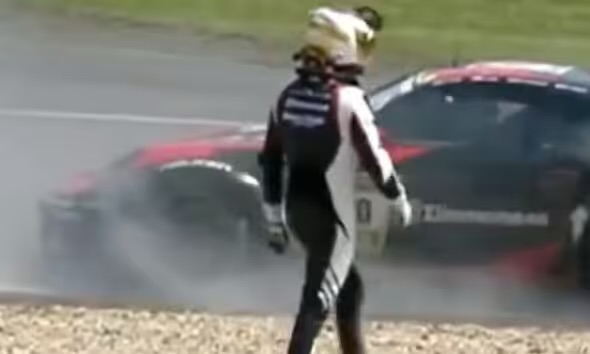
The opening qualifying session for the legendary Nürburgring 24 Hours was thrown into chaos after a frightening crash involving two Porsche cars brought the action to a halt in terrifying fashion.
Just minutes into the session at the iconic German circuit, drivers and fans were left stunned when the No. 900 Porsche 911 burst into flames during the early stages of qualifying. The dramatic incident unfolded only 18 minutes after the green light, immediately creating dangerous conditions on one of motorsport’s most demanding tracks.
The car, driven by Alexander Hardt, suffered a sudden issue while navigating the Grand Prix section of the Nürburgring. Smoke quickly began pouring from the rear of the Porsche before flames became visible, forcing Hardt to pull off the racing line and stop near the Xiaomi Corner.
In a tense moment, Hardt quickly climbed out of the stricken vehicle as marshals rushed toward the scene. With the Porsche engulfed in smoke and fire, the German driver attempted to alert approaching competitors to the danger ahead. Standing beside the track, he waved frantically at oncoming drivers in an effort to prevent a secondary collision.
Despite his efforts, disaster struck moments later.
The No. 146 Porsche, driven by Janina Schall, arrived on the scene at speed and was unable to avoid the stationary car. In horrifying scenes, Schall’s Porsche slammed directly into the rear of the burning No. 900 machine, causing major damage to both vehicles.
The violent impact scattered debris across the circuit and immediately triggered concern among teams and officials. Schall’s car came to an abrupt halt after the collision, with visible front-end destruction leaving the Porsche heavily damaged.
Fortunately, early reports indicated that both drivers escaped the incident without serious injury, although the crash instantly became one of the most dramatic moments of the event’s opening day.
The terrifying sequence highlighted just how unforgiving the Nürburgring can be, even during qualifying sessions. Widely regarded as one of the most dangerous and technically demanding circuits in the world, the Nordschleife’s combination of blind corners, rapid elevation changes and high-speed sections leaves little margin for error when incidents occur.
Visibility also appeared to play a significant role in the collision. With smoke spreading across the circuit and the stationary Porsche positioned in a vulnerable area near the racing line, approaching drivers had only seconds to react. Although Hardt desperately tried to signal the danger manually, the speed at which competitors travel around the circuit made avoiding the scene extremely difficult.
Race control quickly responded by neutralising the session as marshals and emergency crews attended the crash site. Firefighters worked rapidly to extinguish the blaze from Hardt’s Porsche while recovery vehicles moved in to clear the wreckage.
The incident sparked widespread discussion throughout the paddock regarding safety procedures and visibility management during endurance racing events. Drivers competing in the Nürburgring 24 Hours regularly face rapidly changing track conditions, traffic from multiple classes and limited reaction time due to the sheer speed of the circuit.
For many watching around the world, the images from qualifying served as another reminder of the dangers drivers continue to face in motorsport despite major advancements in safety technology over recent decades.
The Nürburgring 24 Hours remains one of endurance racing’s most iconic spectacles, attracting huge manufacturers, professional racers and motorsport enthusiasts every year. However, Thursday’s frightening scenes proved that the challenge of conquering the Green Hell remains as intense and unpredictable as ever.
As investigations into the incident continue, teams will now focus on repairing the damaged cars and preparing for the remainder of the event, while organisers assess the circumstances surrounding the dramatic crash that stunned the motorsport world.