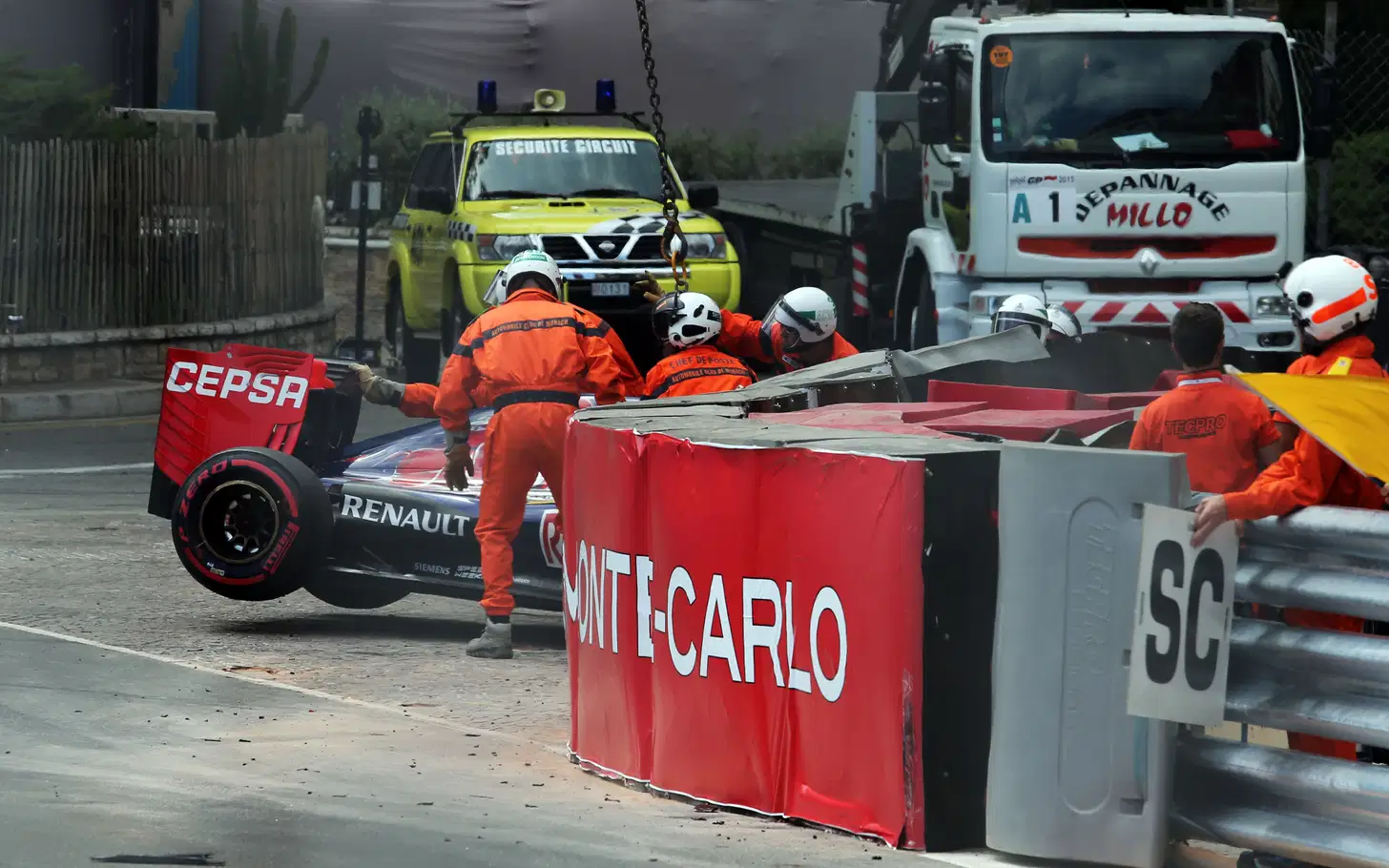

Max Verstappen’s rise to Formula 1 superstardom has been filled with unforgettable victories, championship triumphs, and record-breaking performances. However, long before he became one of the sport’s most dominant drivers, the Dutchman experienced one of the most significant moments of his early career — a dramatic crash that served as both a learning experience and a turning point in Formula 1 history.
The incident occurred during the 2015 Monaco Grand Prix, a race that remains one of the most iconic and challenging events on the Formula 1 calendar. At the time, Verstappen was only 17 years old and competing in his debut F1 season with Toro Rosso. Despite his age, he had already attracted enormous attention throughout the paddock due to his remarkable speed, fearless racing style, and ability to compete against far more experienced drivers.
Monaco, with its narrow streets, unforgiving barriers, and limited overtaking opportunities, has always tested even the most accomplished drivers. For a young rookie still adapting to Formula 1, the challenge was enormous. Yet Verstappen entered the weekend determined to prove himself on one of motorsport’s grandest stages.
During the race, Verstappen showed flashes of the talent that would later make him a multiple-time world champion. He demonstrated strong pace and fought aggressively throughout the event. However, a problem during a pit stop significantly compromised his race. After stalling during the stop and losing valuable time, he dropped down the order and faced an uphill battle to recover positions.
Refusing to give up, Verstappen launched an aggressive comeback. Armed with fresh tyres and youthful determination, he began charging through the field. Every lap saw him pushing harder as he hunted down the cars ahead. His target eventually became Lotus driver Romain Grosjean, who occupied the final points-paying position.
As the race approached its closing stages, Verstappen closed rapidly on Grosjean. The young Dutchman was determined to secure at least one championship point and was searching relentlessly for an opportunity to overtake. The pressure intensified as the two drivers approached Sainte Devote, the first corner of the famous Monaco circuit.
What happened next would become one of the most talked-about moments of the 2015 season.
Running closely behind Grosjean, Verstappen misjudged his braking point and collided with the rear of the Lotus. The impact launched his Toro Rosso into the barriers with tremendous force. The crash registered approximately 30G, making it one of the heaviest accidents of the season.
Spectators watched in shock as debris scattered across the track and Verstappen’s car suffered severe damage. Fortunately, modern Formula 1 safety systems performed exactly as intended. Despite the violent nature of the accident, Verstappen was able to climb out of the wreckage under his own power and walk away without serious injury.
The accident immediately sparked debate throughout the paddock. Verstappen argued that Grosjean had braked earlier than expected, catching him by surprise. According to the Dutch driver, the braking pattern differed from previous laps, leaving him with insufficient time to react.
Grosjean strongly disagreed with that assessment. The French driver insisted that his braking point had remained consistent and rejected any suggestion that he had caused the collision. Following an investigation, race officials examined data from both cars and concluded that Grosjean had actually braked slightly later than on the previous lap.
The stewards ultimately determined that Verstappen was responsible for the accident. As punishment, he received a five-place grid penalty for the following Canadian Grand Prix and was also handed two penalty points on his super licence. It was a costly lesson for the young driver, who learned that Formula 1 requires not only speed but also patience, judgment, and precision.
Yet the consequences of the crash extended far beyond Verstappen’s personal disappointment.
The accident unexpectedly created a historic moment for Formula 1 itself. Following the collision, race officials deployed the Virtual Safety Car system for the first time during a Formula 1 race weekend. The technology had been introduced as a new safety measure designed to slow drivers down in dangerous situations without requiring a full Safety Car deployment.
The Monaco crash became the system’s first significant real-world test, marking a major step forward in Formula 1 safety procedures. In many ways, Verstappen’s accident helped demonstrate the effectiveness of a tool that would later become a regular feature of Grand Prix racing.
The resulting strategic consequences were equally dramatic.
Mercedes, which had been controlling the race with Lewis Hamilton at the front, reacted to the neutralisation period by bringing the British driver into the pits. The team believed the stop would provide a strategic advantage while maintaining track position.
However, the decision backfired spectacularly.
Hamilton emerged from the pit lane behind both Nico Rosberg and Sebastian Vettel. Instead of strengthening his lead, the stop effectively handed track position to his rivals. Rosberg inherited the lead and eventually secured victory, while Hamilton was left frustrated after losing a race he had appeared destined to win.
The incident transformed what had initially been Verstappen’s personal setback into a race-defining moment that influenced the outcome of the Monaco Grand Prix. It also became one of the most discussed strategic errors in Mercedes’ modern Formula 1 history.
Looking back today, the crash offers a fascinating glimpse into Verstappen’s development as a driver. Throughout his career, he has often been praised for his fearless approach and willingness to attack opportunities that others might avoid. Those same characteristics were clearly visible during Monaco 2015. However, the accident also highlighted the fine line between aggression and overcommitment.
Many of Formula 1’s greatest champions have experienced similar learning moments early in their careers. Drivers such as Ayrton Senna, Michael Schumacher, and Lewis Hamilton all endured difficult incidents that ultimately contributed to their growth. For Verstappen, Monaco 2015 became one of those defining experiences.
Over the years that followed, he matured significantly as a racer. While his aggressive instincts remained intact, he gradually developed greater race management skills, improved decision-making, and a deeper understanding of when to push and when to wait. Those qualities would later help him secure multiple world championships and establish himself among Formula 1’s elite competitors.
The Monaco crash remains an important chapter in Verstappen’s story because it illustrates how even future champions must endure setbacks on their path to greatness. What appeared at the time to be a painful mistake eventually became a valuable lesson that contributed to his evolution into one of the sport’s most complete drivers.
More than a decade later, the images of the damaged Toro Rosso against the Monaco barriers still serve as a reminder of how quickly fortunes can change in Formula 1. Yet they also demonstrate the resilience that has defined Verstappen’s career. Rather than allowing the incident to undermine his confidence, he used it as motivation to improve, learn, and eventually become one of the most successful drivers the sport has ever seen.
In hindsight, the crash was far more than a rookie error. It was a moment that influenced Formula 1 strategy, showcased the effectiveness of new safety technology, and provided an early lesson for a driver who would later dominate the sport. For Verstappen, it marked the beginning of a journey that transformed a talented teenager into a global motorsport icon.