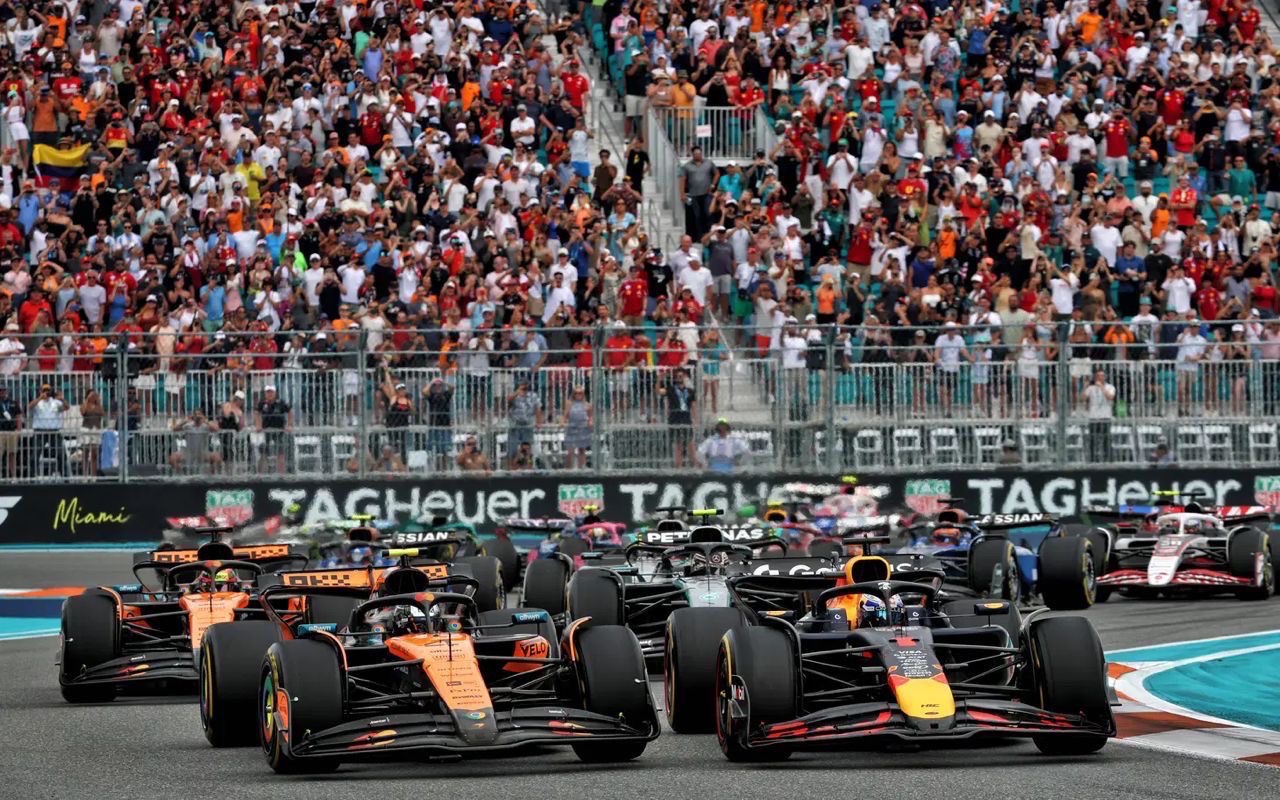
The 2026 Miami Grand Prix weekend took another dramatic turn when the FIA confirmed a major post-session penalty, plunging the sprint event into controversy and reshuffling part of the order. What had already been an action-packed Saturday became even more chaotic after officials handed down a disqualification-related ruling that left one team frustrated, another vindicated, and fans scrambling to understand the implications.
The centre of the controversy was Alexander Albon, whose sprint qualifying performance initially appeared to be one of the standout midfield efforts. The Williams driver had done an excellent job in the session, advancing into the second phase of sprint qualifying and seemingly securing a respectable grid position for the Miami Sprint. It was a strong showing on a circuit where every tenth of a second matters and where the midfield battle remains incredibly tight.
However, that result did not stand.
Following a post-session review, FIA stewards determined that Albon had exceeded track limits during his decisive SQ1 lap at Turn 6. Although the infringement occurred during the opening segment, it was not identified quickly enough before the start of SQ2. As a result, Albon was allowed to continue participating in the session, setting additional lap times and temporarily retaining his place in the classification.
Once the violation was formally confirmed, the FIA had little choice but to act. The governing body deleted Albon’s offending SQ1 lap, which had been the lap that allowed him to progress. Since he should not have advanced beyond that point, all of his subsequent SQ2 lap times were also removed. That effectively erased his sprint qualifying result and dropped him from a provisional place in the middle of the grid all the way down to 19th for the Sprint.
The ruling triggered immediate confusion in the pit lane. Racing Bulls, whose driver Liam Lawson had narrowly missed the cut for SQ2, quickly realized that an Albon penalty might promote Lawson into the next segment. In a scene that perfectly captured Formula 1’s blend of speed and bureaucracy, Lawson rushed back to his car, helmet on, prepared to rejoin the session if the stewards acted in time.
But the decision came too late.
By the time the FIA finalized the ruling, SQ2 was already underway. Lawson had remained on standby, but there was no procedural mechanism to retroactively insert him into the session once it had started. As a result, he remained eliminated despite the fact that Albon’s lap should have been deleted earlier. It was a frustrating outcome for both Lawson and Racing Bulls, who were effectively denied the opportunity to compete for a higher sprint grid position.
The FIA acknowledged the unusual sequence of events in its official documentation. The delay in reporting the track-limits breach created a situation where a driver who should have been eliminated was allowed to continue. While the stewards applied the regulations correctly once the infringement was identified, the timing of the review inevitably raised questions about the efficiency and consistency of track-limits monitoring.
For Williams, it was a particularly painful setback. Albon had extracted impressive pace from the car, and the team had every reason to feel optimistic about its sprint prospects. Instead, a promising session was effectively wiped from the record. Rather than starting from a competitive midfield slot, Albon was forced to line up near the back, dramatically reducing his chances of scoring points in the Sprint.
The decision also had broader implications for the competitive order. With Albon relegated, the lower end of the sprint grid was reshuffled, and several drivers inherited improved starting positions. In a championship where even a single point can make a significant difference, such administrative rulings can carry major consequences.
Importantly, this was not a classic disqualification in the sense of a car failing technical inspection after the session. Rather, it was a deletion of qualifying lap times that effectively nullified Albon’s result. Still, the impact was similar: his original performance was removed from the books, and he was stripped of the grid position he had earned on track.
The incident also reignited debate over Formula 1’s handling of track limits. In recent years, the sport has struggled to balance consistent enforcement with timely decision-making. Miami once again demonstrated how even a minor delay can create confusion, alter competitive fairness, and leave teams feeling aggrieved.
Despite the controversy, the FIA’s decision was firmly grounded in the regulations. Exceeding track limits is a clear breach, and the penalty—deletion of the relevant lap time—is well established. The real issue was not the rule itself, but the delayed detection that allowed the situation to escalate.
For Lawson, the episode was especially difficult to accept. He had every reason to believe a late reprieve was possible, only to see that possibility disappear due to procedural timing. While he ultimately could not be reinstated into SQ2, the incident highlighted how quickly fortunes can change in Formula 1.
As the Miami weekend continued, attention quickly shifted back to the track. McLaren capitalized on its pace advantage, with Lando Norris winning the Sprint ahead of teammate Oscar Piastri, while Ferrari’s Charles Leclerc completed the podium. But the Albon controversy remained one of the defining talking points of the day.
Ultimately, the episode served as another reminder that in Formula 1, results are not always final when the chequered flag falls—or, in this case, when qualifying ends. A fraction of a second over the white line can change everything, and in Miami, it certainly did. For Albon and Williams, a promising session turned into bitter disappointment. For Lawson, it was a case of what might have been. And for the FIA, it was another high-profile reminder that speed in decision-making matters almost as much as speed on the racetrack.