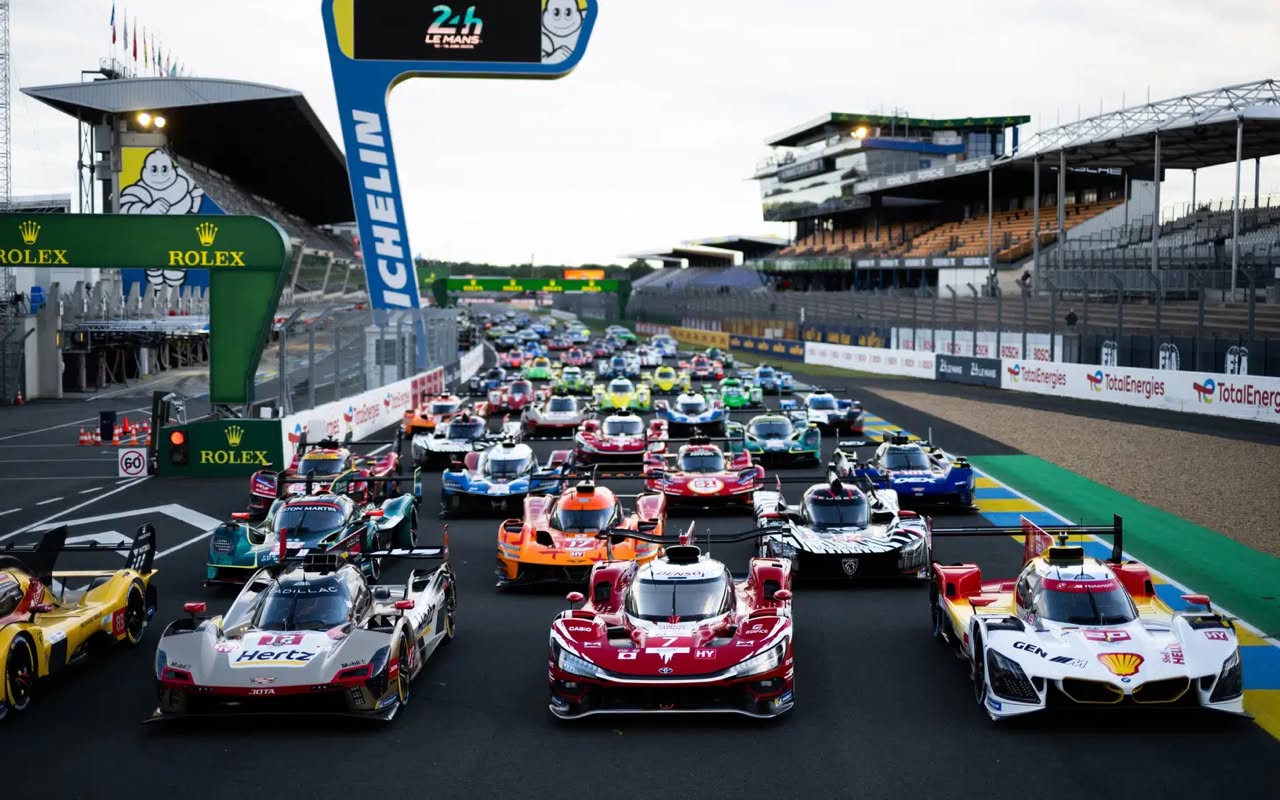

The starting grid for the 2026 edition of the prestigious 24 Hours of Le Mans has now been officially confirmed, but not without drama, last-minute changes, and penalties that reshaped the final order. As always, the legendary endurance race at the Circuit de la Sarthe has delivered a blend of high-speed competition and regulatory intrigue even before the race has begun.
Following an intense qualifying and Hyperpole session, it was BMW that ultimately emerged on top of the grid, securing pole position in what marks a significant milestone for the German manufacturer. The #15 BMW M Hybrid V8, driven by a strong lineup including Kevin Magnussen, Raffaele Marciello, and Dries Vanthoor, delivered a standout performance during Hyperpole. Their fastest lap proved decisive in locking down the coveted first-place start.
However, the road to pole position was not straightforward. Cadillac had initially appeared to have the pace to dominate qualifying, but a costly procedural mistake resulted in a penalty that stripped them of their advantage. One of the Cadillac entries was released prematurely in the pit lane before the official start of the Hyperpole session, violating race control instructions. This infraction ultimately led to the deletion of their fastest lap time, opening the door for BMW to capitalize and claim pole position.
As a result, the #12 Cadillac Hertz Team Jota car, driven by Alex Lynn, Will Stevens, and Norman Nato, had to settle for second position on the grid. While still a strong starting spot, the penalty proved to be a frustrating setback for a team that had shown clear front-running pace throughout qualifying.
Completing the top three on the overall grid is the #35 Alpine Endurance Team entry. With drivers António Félix da Costa, Charles Milesi, and Ferdinand Habsburg, Alpine demonstrated impressive consistency and speed, positioning themselves as serious contenders for the race victory. Close behind them in fourth place is another BMW entry, the #20 car, further underlining the manufacturer’s strong showing this year.
Fifth position is occupied by the #101 Cadillac Wayne Taylor Racing car, which ensures that Cadillac still maintains a strong presence near the front despite the earlier setback. The Hypercar class, which headlines the race, has proven to be incredibly competitive this year, with multiple manufacturers—including BMW, Cadillac, Alpine, Ferrari, and Toyota—all showing race-winning potential.
Beyond the Hypercar category, the LMP2 and LMGT3 classes also saw their grids finalized after qualifying sessions and subsequent adjustments. In LMP2, the #29 entry from Forestier Racing by Panis secured the class pole position, followed by IDEC Sport and Nielsen Racing. The margins between competitors were extremely tight, highlighting the depth of competition in the prototype category.
Meanwhile, in the LMGT3 class, the Heart of Racing Team claimed the top starting position with their Aston Martin entry. They are joined at the front by Vista AF Corse and Akkodis ASP Team entries, all of whom delivered strong performances during qualifying. The GT field remains highly competitive, with multiple manufacturers and teams capable of challenging for class honors over the grueling 24-hour race.
Penalties and procedural infractions were not limited to the Hypercar class alone, as several adjustments across categories ensured that the final grid reflected both performance and compliance with regulations. These changes underline the importance of precision not only on track but also in pit lane operations and adherence to race control directives.
The finalized grid paints a picture of a wide-open contest. BMW’s breakthrough pole position is a major storyline, but it does not guarantee success in a race defined by endurance, strategy, and reliability. Cadillac, despite its penalty setback, remains a formidable threat, while Alpine and other manufacturers are well-positioned to capitalize on any opportunities that arise.
This year’s race, the 94th running of the iconic endurance event, will once again test the limits of both man and machine over 24 relentless hours. With a total of 186 drivers participating across all classes, the scale of competition is immense, and the diversity of talent ensures that fans can expect thrilling action throughout the event.
As the green flag approaches, all eyes will be on how the front-runners handle the early stages of the race. While starting position is important, Le Mans is notorious for unpredictability—mechanical issues, weather changes, and strategic decisions often play a decisive role in determining the final outcome.
In summary, the confirmed starting grid for the 2026 24 Hours of Le Mans reflects both exceptional performance and the impact of penalties that reshuffled the order. BMW leads the field from pole, followed by Cadillac and Alpine, while the rest of the grid remains tightly packed with contenders eager to make their mark. With everything set for another classic edition of the race, anticipation is at an all-time high as teams prepare to battle through one of motorsport’s greatest challenges.