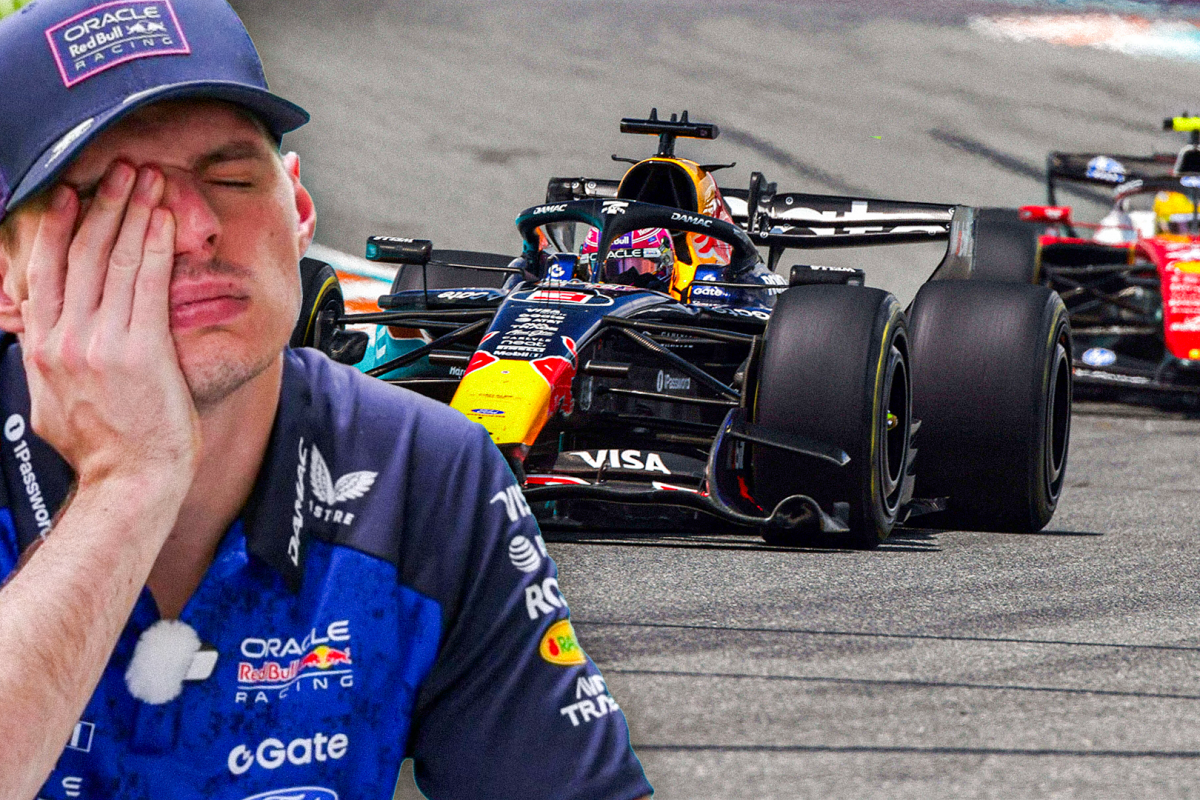
Max Verstappen became the center of controversy after receiving a post-race penalty at the Miami Grand Prix, sparking criticism from fans and pundits across the Formula 1 community. The decision, made by the FIA, came after the race had concluded and quickly ignited debate over consistency and timing in stewarding.
The Red Bull driver had shown a clear improvement in performance during the Miami weekend, with his car appearing significantly more competitive following a recent round of upgrades. Starting from the front row alongside polesitter Kimi Antonelli, Verstappen endured a shaky start but managed to recover in spectacular fashion. After briefly losing control off the line, he produced an impressive save that drew praise from commentator Martin Brundle, who described the moment as “genius.”
Despite the early setback, Verstappen quickly regained composure and began charging through the field with aggressive overtakes. His pace and determination allowed him to climb back into contention, reinforcing the impression that Red Bull had made meaningful progress during the break in the Formula 1 calendar.
However, the race took a controversial turn following his pit stop. It was suspected that Verstappen may have crossed the white line at the pit lane exit — a violation that typically results in a penalty if confirmed. The incident was investigated by stewards, but no immediate verdict was delivered during the race.
Instead, the FIA chose to review the situation after the chequered flag. Upon further analysis of multiple camera angles and onboard footage, officials concluded that Verstappen’s left-front tyre had indeed crossed the solid white line marking the pit exit. As a result, a five-second time penalty was added to his race result.
The delayed nature of the decision raised eyebrows, and criticism soon followed. Among those voicing disapproval was Dutch commentator Olav Mol, who strongly disagreed with the stewards’ ruling. Taking to social media, Mol argued that the penalty lacked sufficient justification and questioned the interpretation of the available footage.
Mol suggested that a closer inspection of Verstappen’s onboard video did not convincingly support the stewards’ conclusion. He went as far as to imply that the officials were overly eager to issue a penalty, remarking that the decision seemed unnecessary. In his view, the punishment did not match the severity — or even the existence — of the infringement.
The FIA defended its approach by explaining that the initial delay was due to insufficient clear evidence during the race. According to the stewards, only after reviewing additional footage post-race were they able to confirm the breach. Verstappen himself reportedly stated that he was rejoining the track under a full course yellow when the incident occurred, but this did not alter the final judgment.
Interestingly, the penalty had little impact on the final standings. Due to a separate and more severe 20-second penalty handed to Charles Leclerc, Verstappen’s finishing position remained unchanged after the results were adjusted.
Nonetheless, the incident has reignited discussions about the consistency and transparency of officiating in Formula 1. Critics argue that delayed penalties can undermine the integrity of the race, while others believe that accuracy should take precedence over immediacy.
The debate surrounding Verstappen’s Miami penalty highlights ongoing tensions between drivers, officials, and fans, as Formula 1 continues to grapple with the challenge of delivering fair and timely decisions in a fast-paced, high-stakes environment.