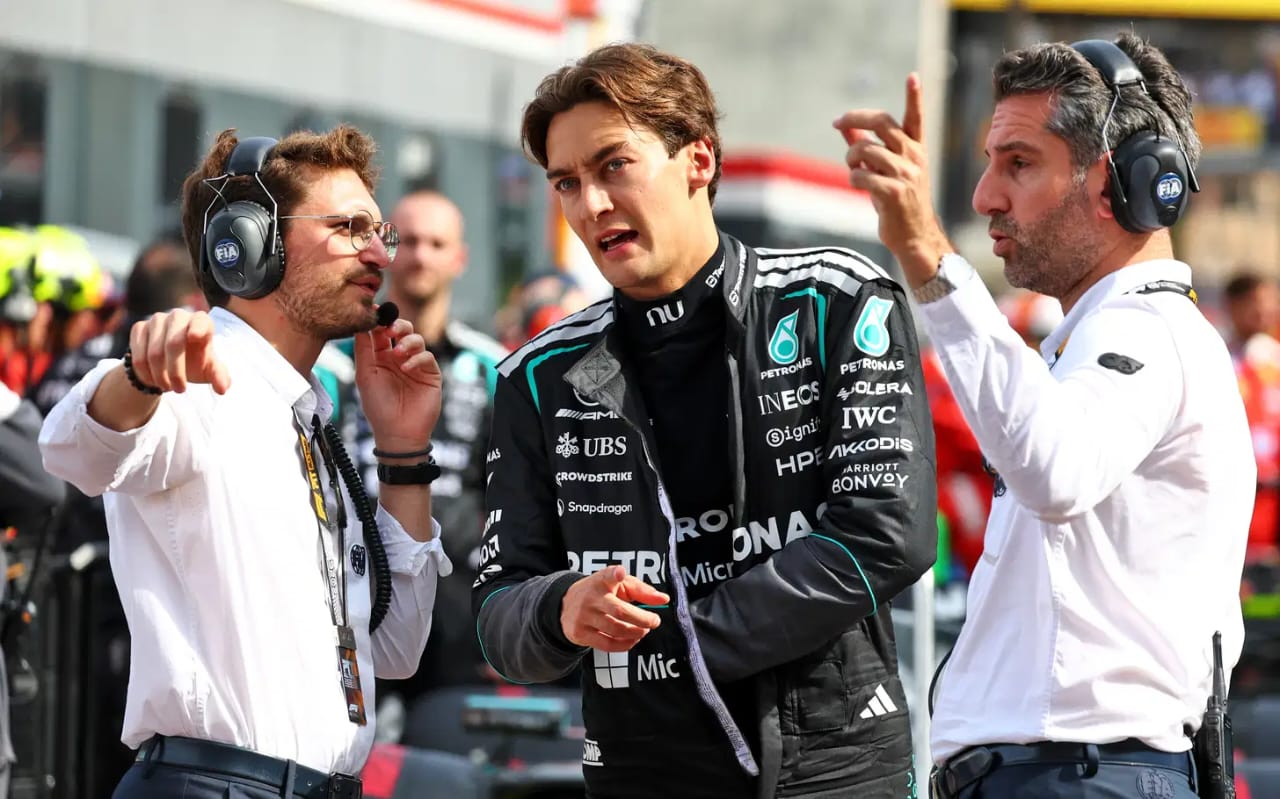

George Russell has openly expressed his frustration following a dramatic and costly sequence of events at the 2026 Monaco Grand Prix, where a combination of penalties and confusion ultimately derailed what could have been a strong race result for the Mercedes driver. In the aftermath, Russell did not hold back in pointing fingers, suggesting that external factors—particularly technical issues and race management decisions—played a significant role in what he described as an excessively harsh punishment.
The controversy began with what appeared to be a relatively minor infringement. During the race, Russell was found to have marginally exceeded the pit lane speed limit. Such infractions are not uncommon in Formula 1, especially on tight and complex circuits like Monaco, where the margin for error is extremely small. As a result, he was handed a standard five-second time penalty, a punishment that several other drivers also received during the race for similar violations.
However, what initially seemed like a manageable setback quickly escalated into a far more damaging situation. When Russell entered the pits to serve his penalty, there was confusion within the Mercedes team regarding the correct procedure and timing. Due to this miscommunication, the five-second penalty was not properly served during his pit stop. This error triggered a much more severe sanction from the FIA: a drive-through penalty.
A drive-through penalty in Formula 1 is significantly more punishing than a simple time addition. It requires a driver to pass through the pit lane at reduced speed without stopping, costing valuable time and track position. For Russell, this proved devastating. He was forced to serve the penalty late in the race, which effectively ended his chances of finishing in a competitive position.
Understandably, Russell was furious. Speaking after the race, he questioned both the origin of the initial penalty and the severity of the follow-up punishment. According to him, the root cause may not have been driver error at all, but rather a technical issue affecting multiple competitors.
Russell pointed out that several drivers were penalized for pit lane speeding by extremely small margins—sometimes as little as 0.1 km/h over the limit. He argued that such minimal differences could indicate a systemic or software-related problem rather than deliberate or careless driving. In his view, the penalties handed out did not fairly reflect the nature of the alleged violations.
He further explained that he believed he had engaged the pit limiter correctly before crossing the designated line, which should have ensured compliance with the speed restriction. The fact that he and others were still penalized raised serious concerns for him about the reliability of the system used to monitor pit lane speeds.
Beyond the technical argument, Russell was particularly critical of how the situation escalated. While he acknowledged that a five-second penalty was not ideal, he described it as manageable and not race-ending. The real issue, in his opinion, was the disproportionate nature of the drive-through penalty that followed.
From his perspective, the failure to correctly serve the initial penalty was the result of confusion during a high-pressure moment, not an intentional attempt to gain an advantage. As such, he felt that the additional punishment was unnecessarily harsh and ultimately ruined his race.
“It just didn’t make sense,” Russell suggested in his post-race comments, emphasizing that the penalty “didn’t fit the crime.”
The timing of the drive-through penalty further compounded the damage. Due to a red flag interruption and subsequent restart, Russell had to serve the penalty in the closing stages of the race. This timing caused him to drop dramatically down the order, finishing well outside the points despite showing competitive pace earlier in the event.
The consequences extended beyond just a poor race result. The Monaco Grand Prix is one of the most important races on the Formula 1 calendar, and missing out on points can have a significant impact on championship standings. For Russell, the result represented a major setback in his title campaign, especially coming after another disappointing outing in Canada.
He lamented that the combined effect of these incidents had cost him a substantial number of points—points he believed were lost due to circumstances beyond his control rather than a lack of performance. In a championship battle where consistency is crucial, such setbacks can prove decisive.
It is also worth noting that Russell was not the only driver affected by penalties during the Monaco race. Several competitors, including high-profile names, were also sanctioned for pit lane speeding and other infractions. However, the impact on Russell was particularly severe due to the chain reaction of penalties and the timing of their enforcement.
The broader situation has sparked debate within the Formula 1 community about the consistency and fairness of FIA rulings. While the governing body is tasked with enforcing regulations to ensure safety and fairness, incidents like this raise questions about whether the penalties always align with the severity of the offenses.
For Russell, the frustration is clearly about more than just one race. It reflects a growing concern about how small margins and technical inconsistencies can lead to disproportionately large consequences in a sport where precision is everything.
Despite the setback, Russell is expected to regroup and continue fighting in the championship. Formula 1 seasons are long and unpredictable, and while Monaco dealt a heavy blow, there are still many races ahead. However, the incident will likely remain a talking point—not just for Russell and Mercedes, but for the wider sport—as teams and officials examine what went wrong and how similar situations can be avoided in the future.
In summary, Russell’s Monaco ordeal highlights the fine line between minor infractions and major consequences in Formula 1. What began as a slight pit lane speed violation quickly spiraled into a race-defining issue, leaving the Mercedes driver frustrated and searching for answers. Whether due to software glitches, team miscommunication, or strict rule enforcement, the episode underscores the high-stakes nature of the sport and the importance of clarity, consistency, and precision at every level.