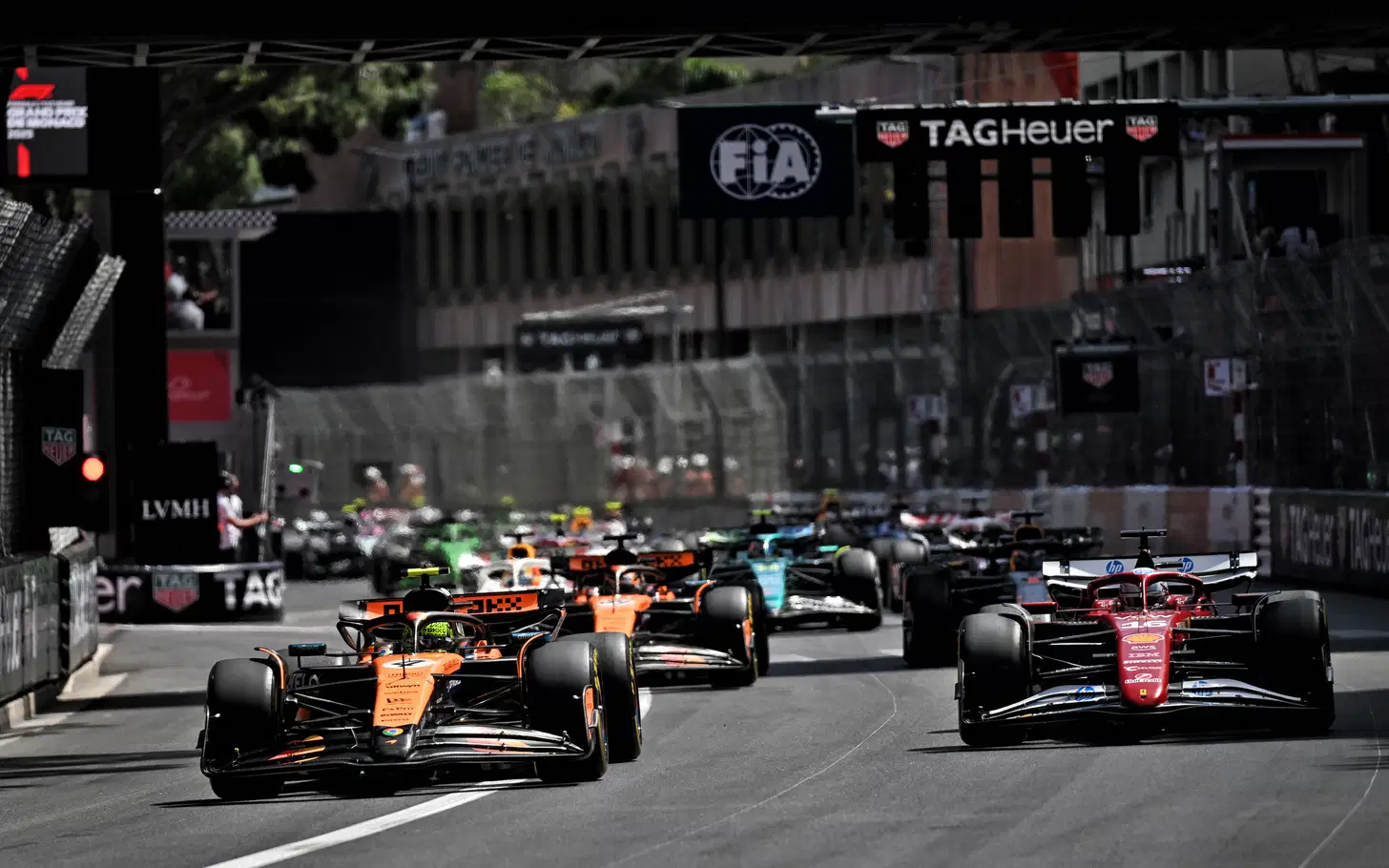
Formula 1’s revolutionary active aerodynamics system has become one of the defining features of the 2026 season, dramatically changing how cars behave on straights and through corners. However, when the championship heads to the legendary streets of Monaco, drivers and teams will face a very different challenge. The FIA has confirmed that active aero will not be used during the Monaco Grand Prix weekend, meaning the cars will effectively remain in maximum downforce configuration throughout the event.
The decision has sparked widespread discussion among teams, fans, and analysts because active aero has been central to the new era of Formula 1. Introduced as part of the sweeping 2026 technical regulations, the system allows both the front and rear wings to automatically adjust depending on the section of track the cars are travelling through. On long straights, the wings flatten into a low-drag setup to improve speed and energy efficiency. In corners, they return to a higher-downforce position to maximize grip and stability.
This technology effectively replaced the old DRS system that Formula 1 used for many years. Instead of only opening the rear wing during overtaking situations, the new system constantly adapts the car’s aerodynamic profile around the lap. Drivers have already been learning how to manage the different modes since the season began, with circuits like Canada featuring several designated “Straight Mode” zones where the wings shift into low-drag configuration.
Monaco, however, presents a completely unique situation. Unlike most modern Formula 1 tracks, the Monte Carlo circuit is extremely tight, narrow, and twisty. There are very few genuine straights around the lap, and most sections of the circuit require maximum grip rather than outright speed. Because of this layout, the FIA concluded that the risks associated with active aero outweighed the potential benefits.
One of the main reasons behind the ban is safety. The governing body carefully studies every circuit before assigning Straight Mode zones, taking several important factors into account. A key rule is that each activation zone must last longer than three seconds. This requirement exists to prevent drivers from constantly switching between modes in rapid succession, which could increase workload and create instability in dangerous sections of track.
Monaco’s layout simply does not provide enough suitable areas to satisfy this requirement. Even the famous start-finish straight is considered too short for effective activation. The FIA determined that opening the wings for such brief moments would deliver very little performance advantage while potentially increasing risks significantly.
Another important factor is tyre grip. Formula 1 officials must ensure that the cars remain stable and predictable in every condition, from low-fuel qualifying laps to long race stints with worn tyres. Monaco’s walls are incredibly close to the racing line, leaving almost no room for error. Any sudden change in aerodynamic balance could have serious consequences on such a demanding street circuit.
The FIA was also concerned about corner entry speeds becoming too high. In some races earlier this season, activation zones were adjusted or shortened specifically to prevent drivers from arriving at corners too quickly. At Monaco, this issue becomes even more critical because many corners immediately follow short acceleration zones. The narrow streets and limited run-off areas mean there is little margin for mistakes.
Particular attention was reportedly given to the Tunnel section and the approach to the Nouvelle Chicane. If drivers were allowed to use low-drag wing settings through this part of the circuit, speeds could rise to dangerous levels before heavy braking zones. Officials ultimately decided it was safer to keep the wings locked in their cornering configuration for the entire weekend.
As a result, Monaco will become the first race of the 2026 season without active aero functionality. Cars will effectively operate permanently in “Corner Mode,” maximizing downforce at all times. This setup should provide greater stability and grip through the circuit’s many slow-speed corners, but it will also reduce top speed on the limited straights.
Although active aero has been disabled, another major 2026 feature will still remain available: Overtake Mode. This new system replaced traditional DRS as Formula 1’s primary overtaking assistance tool. Rather than physically opening a wing, Overtake Mode works through the hybrid power unit by allowing drivers to deploy additional electrical energy.
When activated, drivers receive extra power from the electric systems, enabling them to maintain higher speeds for longer periods. However, unlike active aero, Overtake Mode is only available under certain conditions. Drivers must remain within one second of the car ahead at a designated detection point to gain access to the boost on the following lap.
For Monaco, the detection point has been placed between Turns 16 and 17, while the activation point comes between Turns 18 and 19 leading onto the start-finish straight. Since this is one of the few sections where cars can accelerate fully, officials believe it remains a relatively safe place to allow temporary power boosts.
The FIA has also introduced an additional precaution specifically for Monaco. A revised engine mapping system known as “Rev 1” will reduce the deployment of electrical power earlier than usual. Under normal circumstances, the MGU-K delivers its maximum power boost until cars reach around 290 km/h. In Monaco, however, this reduction will begin at approximately 200 km/h.
This adjustment is another safety measure designed to prevent excessive speeds on the narrow street circuit. By tapering off electrical assistance sooner, Formula 1 hopes to maintain better control over corner entry speeds and reduce the chances of accidents in one of the most unforgiving venues on the calendar.
The decision to disable active aero has generated mixed reactions from fans. Some supporters believe the absence of Straight Mode will not make much difference because overtaking at Monaco has always been extremely difficult regardless of regulations. Others argue that removing the system could actually improve racing slightly by reducing aerodynamic complexity and creating more traditional car behavior.
Many fans online joked that Monaco effectively has “no straight zones” rather than “Straight Mode zones,” highlighting the circuit’s famously compact design. Others pointed out that the race may feel reminiscent of older Formula 1 eras before DRS existed. Despite this nostalgia, many still expect qualifying to remain the highlight of the weekend, as Monaco’s narrow streets make overtaking notoriously challenging.
The Monaco Grand Prix has always occupied a special place in Formula 1 due to its unique character, glamour, and history. The removal of active aero for the event only reinforces how different the circuit is from every other track on the calendar. While the rest of the season showcases the sport’s futuristic aerodynamic technology, Monaco will instead emphasize precision driving, mechanical grip, and driver confidence above all else.
Ultimately, the FIA’s choice reflects Formula 1’s continuing balance between innovation and safety. Active aero may represent the future of the sport, but Monaco’s legendary streets remain too demanding and unforgiving for the system to operate safely. For one weekend at least, drivers will tackle Monte Carlo in a more conventional aerodynamic setup, adding another distinctive chapter to the history of one of Formula 1’s most iconic races.