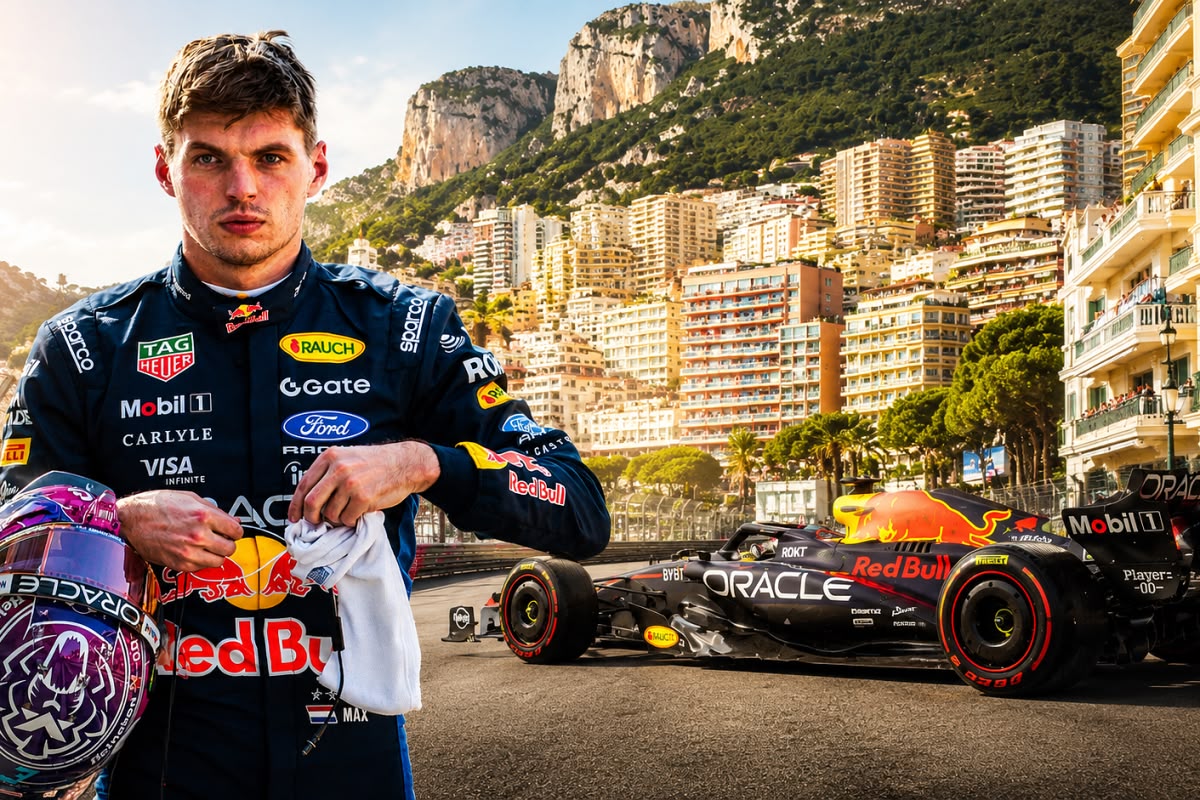

Fresh concerns have emerged from reigning world champion Max Verstappen as he prepares for the prestigious Monaco Grand Prix, with the Red Bull driver openly voicing discomfort about the physical toll of his car and the unique demands of the iconic street circuit. His remarks have added a new layer of intrigue to an already unpredictable 2026 Formula 1 season, where Red Bull have struggled to match the pace of their rivals.
Verstappen’s worries are not centered on a sudden injury in the traditional sense, but rather on an ongoing physical issue linked to the performance characteristics of the current Red Bull car. The Dutchman has been candid about the strain he has been experiencing, particularly with his back, which he says has been negatively affected by the car’s behavior over uneven surfaces.
The issue stems from a well-documented weakness in Red Bull’s 2026 machine—its difficulty in handling bumps and kerbs effectively. While Formula 1 cars are engineered to deliver maximum performance through downforce and aerodynamic efficiency, they can also become extremely uncomfortable, especially when ride quality is compromised. For Verstappen, this has translated into a physically demanding experience behind the wheel, particularly on circuits that are far from smooth.
Monaco, widely regarded as one of the most challenging races on the calendar, presents exactly that kind of environment. The narrow streets of Monte Carlo, combined with constant elevation changes and aggressive kerbs, make it a notoriously bumpy circuit. Drivers are required to extract maximum performance while navigating tight corners and unpredictable surfaces, leaving little room for error—or comfort.
Verstappen has made it clear that he does not expect the situation to improve heading into the race weekend. Speaking about the upcoming event, he admitted that circuits with rough surfaces are particularly problematic for Red Bull at the moment. His comments highlight a deeper issue with the car’s setup philosophy, which currently struggles to balance downforce and suspension compliance in a way that can effectively absorb bumps.
In fact, the reigning champion went as far as joking that he might need a “new back” to get through the Monaco weekend, underlining the seriousness of the physical discomfort he has been enduring. While the comment was delivered with a touch of humor, it reflects a genuine concern about the cumulative strain placed on his body.
The problem is not entirely new. Verstappen has been dealing with similar issues throughout the early part of the season, including at the Canadian Grand Prix, where he reported significant difficulties with the car’s ride quality. During that race weekend, he described how the instability of the car made it hard to maintain consistent control, even to the point where his feet were struggling to stay planted on the pedals due to the bouncing motion.
Such conditions are not only uncomfortable but can also impact performance. Formula 1 drivers rely heavily on precision and consistency, and any disruption to their physical stability can lead to reduced confidence and slower lap times. In a sport where margins are measured in thousandths of a second, even minor discomfort can have major consequences.
For Red Bull, this issue represents a significant technical challenge. The team, which once dominated the sport with its superior car design, has found itself on the back foot in the 2026 season following the introduction of new regulations. These changes have reshaped the competitive landscape, with other teams—particularly Mercedes—emerging as stronger contenders.
The transition to the new rules has not been smooth for Red Bull, and Verstappen’s comments suggest that the team is still searching for solutions. While improvements have been made on smoother circuits, the underlying problem persists on tracks like Monaco, where the limitations of the car are more pronounced.
Adding to the complexity is the nature of the Monaco Grand Prix itself. Unlike traditional race tracks, Monaco is a street circuit with unique characteristics that amplify any weaknesses in a car’s setup. The tight confines and lack of overtaking opportunities mean that qualifying performance is crucial, placing even greater pressure on drivers to push their cars to the limit.
However, pushing the car to its limits under physically taxing conditions could further exacerbate Verstappen’s discomfort. The constant jarring from bumps and kerbs, combined with the intense concentration required to navigate the circuit, creates a demanding environment that tests both driver and machine.
Despite these challenges, Verstappen remains determined to compete at the highest level. His comments do not suggest that he is considering sitting out the race or scaling back his efforts. Instead, they reflect a realistic assessment of the obstacles he faces and the work that still needs to be done to address them.
Red Bull team management has also acknowledged the issue, emphasizing that it is part of an ongoing development process. While they remain confident that the problem can be resolved over time, there is no immediate fix, meaning Verstappen may have to endure the discomfort for the foreseeable future.
Interestingly, this situation also highlights the broader physical demands of modern Formula 1 cars. The current generation of vehicles, shaped by ground-effect aerodynamics and new technical regulations, can place significant strain on drivers, particularly in areas like the back and neck. Verstappen’s experience is a reminder that even the sport’s top athletes are not immune to these challenges.
As the Monaco Grand Prix approaches, all eyes will be on how Verstappen manages both his physical condition and the performance limitations of his car. While he has proven time and again that he can overcome adversity, this particular challenge presents a unique test—one that combines technical, physical, and strategic elements.
Ultimately, the outcome will depend not only on Verstappen’s resilience but also on Red Bull’s ability to extract the best possible performance from a car that is currently far from perfect. In a season already defined by uncertainty and shifting dynamics, the Monaco Grand Prix could prove to be another pivotal moment.
For fans, the situation adds an extra layer of drama to one of Formula 1’s most iconic races. Whether Verstappen can push through the discomfort and deliver a competitive performance remains to be seen, but one thing is certain: the road to success in Monaco has rarely looked more challenging for the reigning champion.